
TL;DR
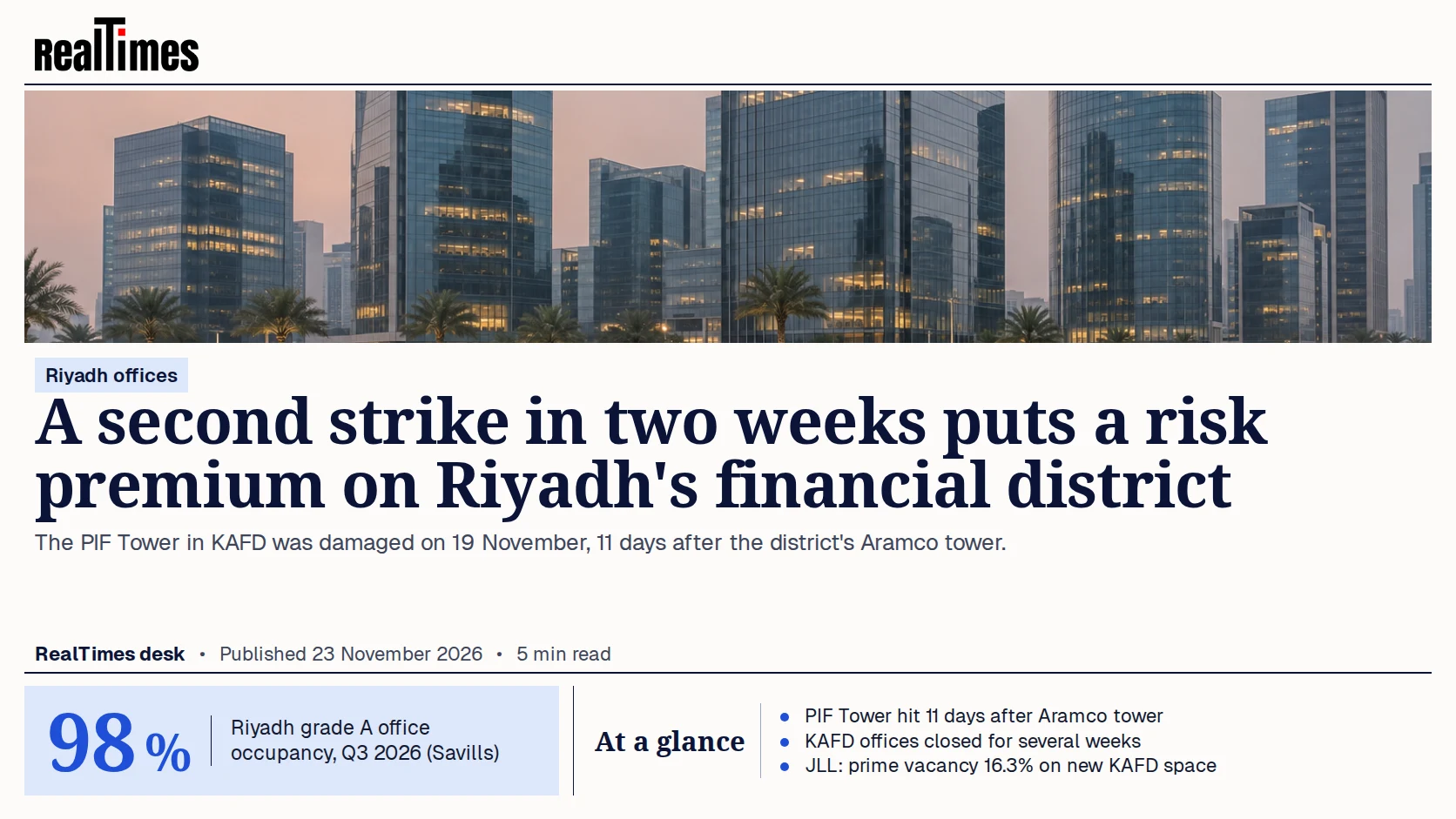
- On 19 November a Houthi attack damaged several floors of the PIF Tower and nearby buildings in Riyadh's financial district, Saudi Civil Defence said (NBC News, Al Jazeera), 11 days after the Aramco tower in the same district was hit on 8 November (AFP via Al-Monitor).
- Offices in the King Abdullah Financial District (KAFD) had already been closed for several weeks, and some businesses do not expect them to reopen until next year, Semafor reported.
- On grade A space the brokers agree: 98% occupancy for Savills, 3.0% vacancy for JLL. JLL's prime vacancy rose to 16.3% as new KAFD prime supply arrived vacant (JLL).
- In our view, the risk premium is clearest in insurance: by April, a $100m war and terrorism policy in the Gulf cost about $5m a year, against $250,000 before hostilities, according to Aon (Semafor).
In our view, for Riyadh's office market the second hit counts for more than the first. The 80-storey PIF Tower stands in KAFD (Gulf News) and is the headquarters of the sovereign wealth fund (NBC News). After the 19 November attack, entrances to the district were closed and people were evacuated, Reuters reported. One damaged tower is an incident; two in the city's prime office address become a location question that occupiers, insurers and valuers all have to answer.
Why does KAFD carry so much of Riyadh's office market?
Its tenants explain why. The district houses the headquarters of the sovereign wealth fund and the Saudi stock exchange, as well as some of the kingdom's biggest home-grown companies, AFP reported.
It also sets the top of the rent scale. Savills' Zone A is the central core anchored on KAFD (EnterpriseAM). It still commands the highest average rent of the four zones Savills tracks, SAR 2,860 per sq m a year (Savills). That rent eased 0.7% on the quarter and 0.3% on the year (Savills).
The core was already crowded before the strikes, with demand drawn by the regional headquarters push (EnterpriseAM). In the third quarter, KAFD and its surroundings stayed the focus of occupier interest, while availability and access were encouraging businesses to consider locations beyond core KAFD, Savills found. Zone D, on the western side of the city, rose 9.8% on the year as demand spilled out of the saturated core (EnterpriseAM).
How full are Riyadh's grade A offices?
Close to full, on both brokers' counts. Grade A occupancy held at 98% in the third quarter of 2026, Savills reported on 28 October, and JLL puts Riyadh grade A vacancy at 3.0% (JLL). Prime vacancy, a separate tier, rose to 16.3% as new KAFD prime supply arrived vacant, a spike JLL expects to be temporary (JLL).
The two firms also agree on behaviour. As supply grows across Saudi Arabia, occupiers are seeking better terms. Landlords are answering with incentive packages, ready-fitted space and adaptable leases rather than cuts to headline rents, according to JLL. Savills sees occupiers favouring shorter renewals and keeping flexibility before they commit to expansion (Savills).
Riyadh offices in the third quarter of 2026: two broker readings
| Measure | Savills | JLL |
|---|---|---|
| Headline | Grade A occupancy 98% | Grade A vacancy 3.0%; prime vacancy 16.3% on new KAFD supply |
| Rents | Zone A SAR 2,860 per sq m a year, down 0.7% on the quarter | Prime SAR 3,610 per sq m a year, down 0.5% on the year |
| Renewals | Five-year rent controls give occupiers cost certainty | Rent freeze: corporates renew at existing rates |
| Supply | More than 2.5 million sq m of grade A due 2026 to 2030 | Stock of 9.82 million sq m after new prime supply in KAFD |
Source: Savills, 28 October 2026; JLL, Kingdom of Saudi Arabia Office Market Dynamics Q3 2026 and full report.
What has changed for occupiers?
Attendance, first of all. Offices in KAFD have been closed for several weeks, and many businesses in Riyadh's other tower blocks have told staff to work from home until further notice, Semafor reported on 19 November. The strike on the fund's head office is likely to delay reopening further, according to the same Semafor report.
Rent freeze rules in Riyadh mean corporates are renewing leases at existing rates, and only a small share of landlords can achieve increases, JLL said. Savills describes five-year rent controls that give occupiers greater cost certainty (Savills).
Where does the risk premium show first?
In our view, in the insurance bill. Traditional commercial insurance policies do not cover armed conflict, so property owners and developers turn to the specialty war market, Semafor explained in April. At that point, a $100m war and terrorism policy in the Gulf that cost $250,000 a year before hostilities ran to about $5m a year, Aon's risk capital business told Semafor.
For valuers, the inputs now pull in different directions. Savills expects more than 2.5 million sq m of new grade A space between 2026 and 2030, with some completions due this year likely to slip into later years (Savills). Riyadh renewals run at existing rates and Saudi landlords are paying incentives (JLL).
Why it matters
Our view: KAFD's pricing power rested on scarcity, and the strikes test whether scarcity is enough. If KAFD offices stay closed into next year, as some businesses told Semafor they expect, then the new KAFD prime space behind the 16.3% prime vacancy JLL reports takes longer to fill than the temporary spike JLL expects, and occupiers can push harder for the incentives and flexible terms JLL already sees.
If war and terrorism cover stays near the $5m a year Aon cited in April for a $100m policy while the rent freeze keeps renewals at existing rates, then net income carries the risk premium before headline rent does. If the more than 2.5 million sq m due by 2030 arrives while demand keeps spilling into Zone D, then Zone A's lead at SAR 2,860 per sq m narrows.