TL;DR
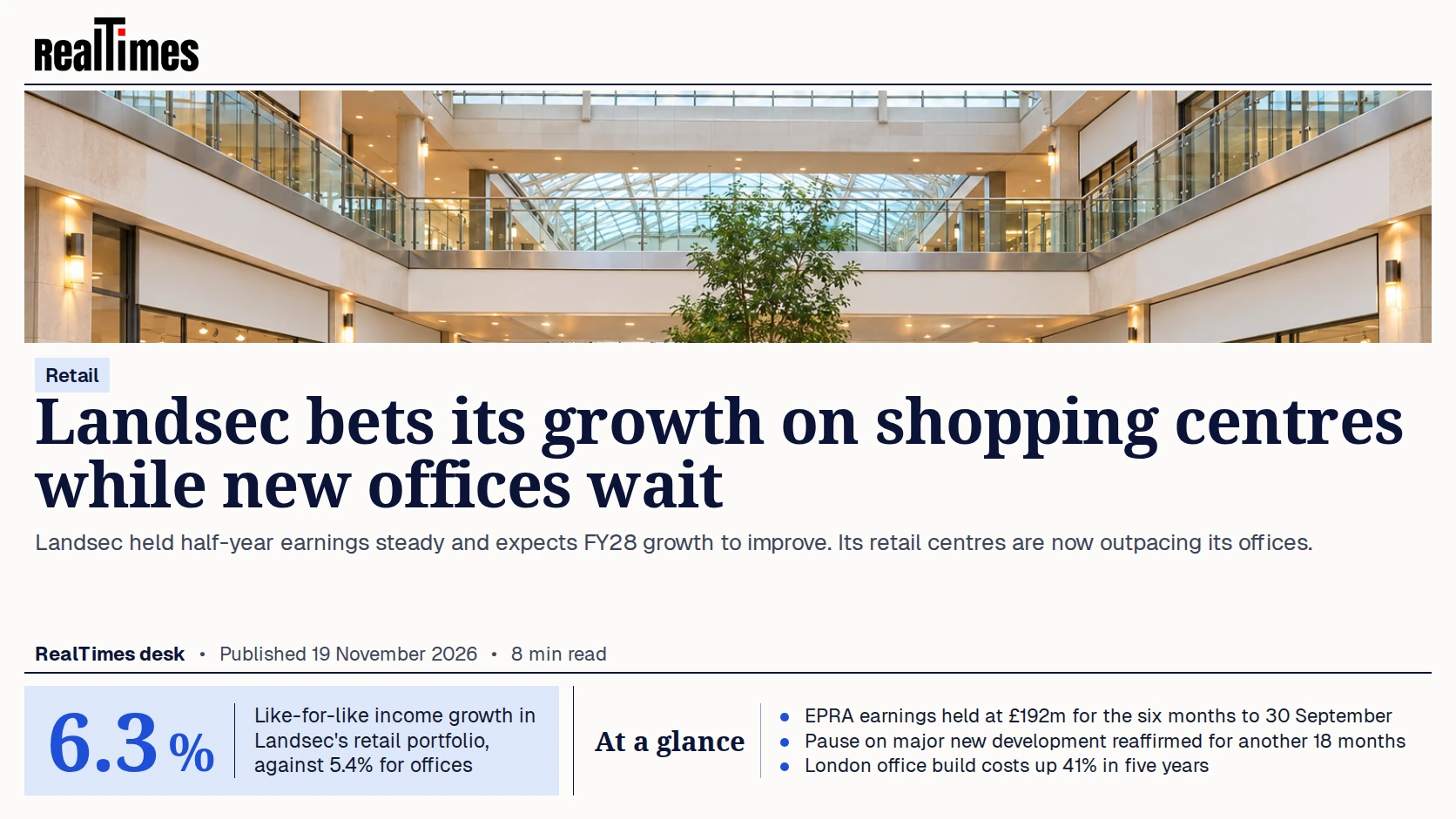
- Landsec held EPRA earnings at £192m for the six months to 30 September and expects improved high-single-digit EPS growth in FY28, with FY27 stable as previously guided.
- Its retail portfolio grew like-for-like income by 6.3%, against 5.4% for offices, and its retail lettings signed or in solicitors' hands came in 12% above estimated rental value.
- Landsec reaffirmed its pause on major new development for another 18 months, and disclosed that London office build costs have risen 41% in five years.
Landsec, the London-listed owner of offices and shopping centres, published its half-year results on 13 November. The headline numbers barely moved. What moved was the balance of the business: shopping centres are now doing more of the work, and new offices are being left on the drawing board.
What did Landsec report?
A steady half and a firmer view of the year after next. EPRA earnings were unchanged at £192m, and earnings per share edged up to 25.9p from 25.8p, despite the loss of income from the sale of Queen Anne's Mansions. The interim dividend rises 2.1% to 19.4p.
Like-for-like net rental income grew 6.2% across the group, up from 4.6% for the last financial year. Profit before tax rose to £243m from £98m, helped by an £88m valuation surplus.
The outlook is where the change sits. Landsec expects FY27 earnings per share to be stable, in line with previous guidance, and FY28 earnings per share to see improved high-single-digit percentage growth. It also sees the potential for FY30 earnings per share to reach about 62p, about 5% a year of compound growth from FY27.
Why are shopping centres pulling ahead?
On the main operating measures in the release, retail beat offices this half. Retail-led like-for-like income rose 6.3%, against 5.4% for the office-led portfolio. Retail occupancy rose to 97.8%, which Landsec calls its highest level in over 20 years, while office occupancy slipped to 97.7%, mostly because of lease expiries at its Paddington asset.
Tenants are doing better too, by Landsec's own count. Sales in its centres rose 3.7%, against a 1.4% fall for the UK national average, and footfall grew 1.6% against 0.1% nationally.
Landsec half-year: retail ahead of offices
The offices are not weak. Landsec says office income growth of 5.4% came in ahead of its expectation, and that the gap between current and market rents in the portfolio has widened to 20%. The difference is where new money goes.
| Measure, six months to 30 September 2026 | Retail | Offices |
|---|---|---|
| Like-for-like income growth | 6.3% | 5.4% |
| Lettings against ERV | 12% above | 7% above |
| EPRA occupancy | 97.8%, up 10bps | 97.7%, down 90bps |
Source: Landsec.
Why is Landsec not building new offices?
Because the sums no longer work for it. Landsec said London office construction costs have risen 41% over the past five years while prime office values stayed flat, Construction Enquirer reported. The results reaffirm an existing pause rather than start a new one. Its committed development exposure is coming down to less than 2% of portfolio value, with no meaningful new commitments planned for another 18 months or so.
The decision lands hard on the building trade. Glenigan said holding back despite strong office leasing demand shows how geopolitical and economic uncertainty is weakening investor confidence, Construction News reported. The Construction Products Association said, according to the same outlet, that it means another 12 months or so of limited construction starts.
Regional plans are narrowing rather than ending. Chief executive Mark Allan told Place North West that the Poulton office at Mayfield in Manchester could start on site next year, and that Mayfield will be Landsec's only residential focus in Greater Manchester over the next couple of years.
Where is the new money going?
Into large shopping centres, a shift that predates these results. In October Landsec launched a £500m share issue to fund the £516m purchase of Metrocentre in Gateshead, near Newcastle, and a further consolidation of its retail holdings. Metrocentre came at a 7.9% net rental income yield, according to QuotedData. That consolidation came on 13 October, when it bought a further 10% of Bluewater for £95m, taking its stake in the Kent centre to 74%.
The share issue has a cost per share. EPRA net tangible assets per share rose to 893p from 882p over the half, but fall to 863p once the new shares are counted. Investors took the results calmly: the shares were up 1.2% at 704p on the morning of 13 November, 159p below the 863p pro forma figure.
Why it matters
Our view: Landsec is now putting its growth on shopping centres and on offices it already owns, not on new buildings. That is a statement about where returns sit today, made by an owner of both.
If retail keeps letting 12% above estimated rental value with occupancy near 97.8%, then rental growth in existing centres, not new schemes, would carry the improved FY28 outlook. If London office build costs keep outrunning values, as the 41% rise against flat values did, then new prime supply stays thin and the 20% gap to market rents in existing offices carries office income instead. If the shares stay below the 863p pro forma net assets, then further retail buying funded by new equity would face a harder test.