

TL;DR
- The property exposure sits in leases and guarantees: Nvidia's 10-Q lists guarantees with a maximum gross exposure of $108.5bn, about $105bn of it on one Ohio campus leased to an OpenAI affiliate.
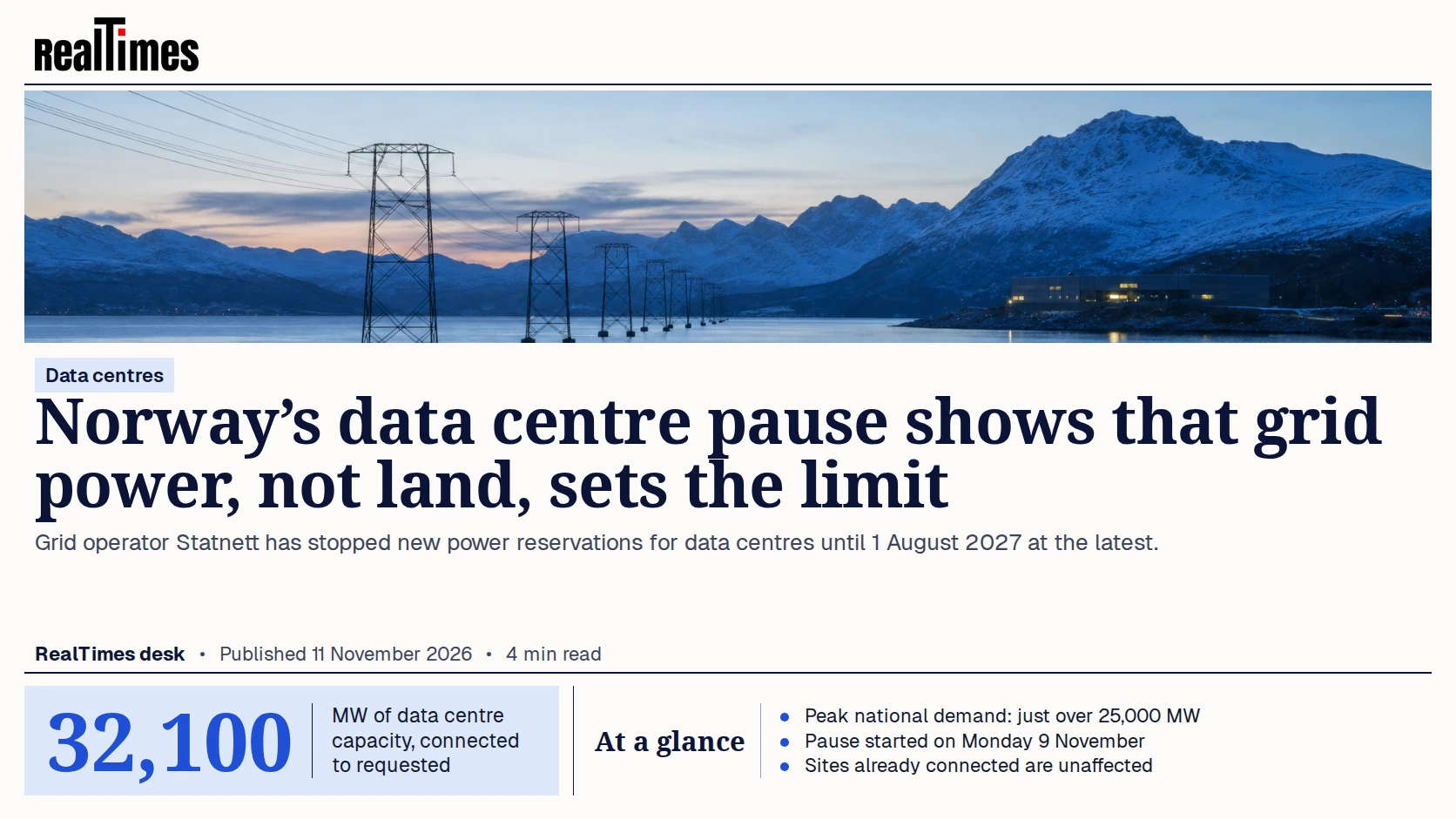
- Rents have held so far: CBRE reports 1.4% primary-market vacancy and more than 80% of 7,481 MW under construction preleased, while power access, not demand, is the scarce input, as Norway's grid operator has paused new grid reservations for data centres.
- The leadership change at Nvidia changed none of those contracts; its board reinstated Jensen Huang on 23 November, according to the company's 8-K.
Data centre real estate increasingly rests on leases to AI tenants, and Nvidia has guaranteed some of those leases, one campus above all. Nvidia's board accepted Jensen Huang's resignation on 11 November and named finance chief Colette Kress interim chief executive, according to the 8-K. On 23 November it reinstated Huang, saying that in reaching the decision it had received input from senior levels of the US government and was confident his return posed no national security risk. The board said its investigation would continue (8-K, Exhibit 99.1). Our earlier piece set out what Nvidia has committed to and guaranteed; this one asks what that exposure means for the asset class.
Are infrastructure funds too dependent on hyperscalers and chip makers?
The data is mixed, and it points to concentration. Nvidia's own 10-Q lists $56bn of commitments and, separately, guarantees with a maximum gross exposure of $108.5bn, of which about $105bn relates to an Ohio campus of roughly 4.25 GW leased to an OpenAI affiliate. A single campus therefore carries most of the guarantee total.
Debt markets have already started to price the difference between tenants. As we reported, a Stargate construction loan sold below par while Blackstone paid about $5B for AWS-leased shells. The desk's reading is that infrastructure funds are less exposed to chip makers than to the credit of the tenant that signs the lease.
Are current data centre rents durable?
So far, yes. CBRE's North America H1 2026 report puts primary-market vacancy at 1.4%, with 7,481 MW under construction and more than 80% of it preleased. Asking rents for 3 to 10 MW users rose 8.3%. JLL's midyear report counts 66 GW under construction in North America, 95% of it pre-committed, and rents up nearly 70% since 2020.
Those figures describe the past six months, a period that includes the sell-off weeks only at its end. Rents are durable while pre-leasing holds; they depend on the same few tenants continuing to spend.
Will land with access to power appreciate faster than traditional industrial land?
Power access is the scarce input. Norway's grid operator Statnett paused new grid reservations for data centres on 9 November, until 1 August 2027 at the latest. We have not found a published like-for-like comparison of powered-land values against traditional industrial land in Europe this year, so the desk treats the premium as a thesis for the expert call below, not as a fact.
Can Poland win a real share of European data centre investment?
CBRE puts Poland's data centre capacity at about 200 MW today, and sees it potentially reaching 500 MW by 2030, as reported by the Warsaw Business Journal. That is small beside the more than 12.1 GW operational across EMEA that Cushman & Wakefield counted in H1 2026. Constraints on grid connections elsewhere in Europe may push some projects east, but the pipeline has to be grid-connected to count.
Why it matters
Our view: the editorial question behind these four is whether data centres are a new, lasting institutional asset class, or whether valuations are becoming too dependent on the AI cycle. If pre-leased campuses with creditworthy tenants keep their rents and powered land stays scarce, then the asset class holds. If the same few tenants slow their spending, then the assets most exposed are unleased or speculative builds, and Nvidia's guarantees, with a maximum gross exposure of $108.5bn, most of it on one campus, show how concentrated the support is.
The test of an asset class is whether income survives a change in sentiment. Data centres with long leases to named tenants pass it today; those depending on one customer's guarantee are priced for that dependence, as the below-par Stargate loan showed, in the desk's view.