
TL;DR
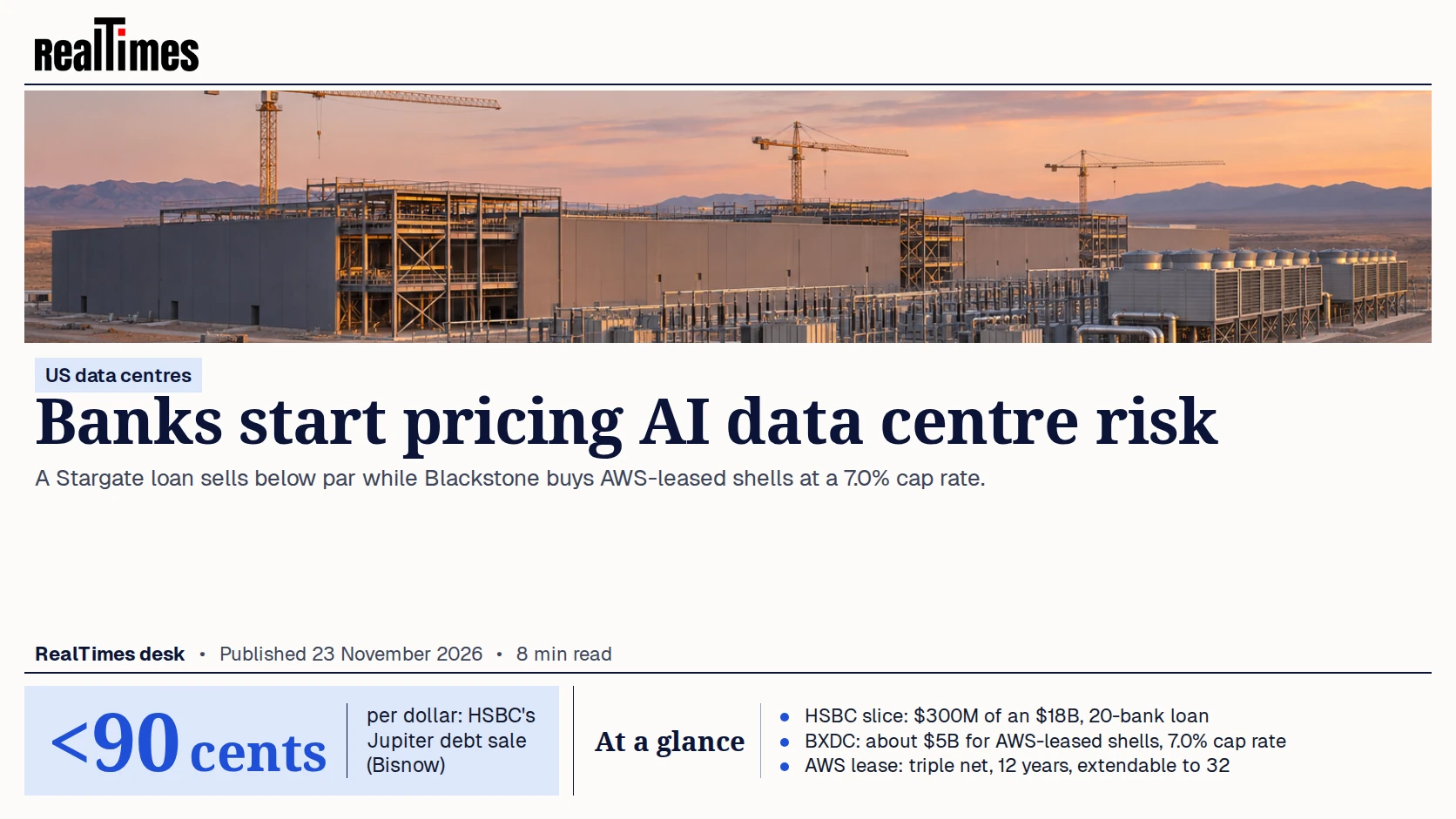
- HSBC sold $300M of construction debt on Project Jupiter, a New Mexico data centre campus, at less than 90 cents on the dollar, according to Bisnow; Bloomberg put the price in the mid-80s, per people familiar with the matter, as carried by The Star.
- On 16 November, a day before the HSBC sale was reported, Blackstone Digital Infrastructure Trust agreed to buy 75% of two joint ventures with Amazon Web Services for about $5B at a 7.0% initial cap rate, with 100% leased back to AWS on a triple-net basis (Blackstone release).
- One campus is priced for the chance that its tenant delays payment; the other for a rent guarantee from AWS. The desk's reading is that tenant credit and lease structure, not power capacity, set the price.
Two data centre deals were reported within a day of each other, and they point in opposite directions. A bank sold part of a loan to one of the most talked-about AI campuses in the United States at a visible discount. A Blackstone vehicle agreed to pay a headline $5B for shells that Amazon will rent for at least 12 years.
What did HSBC sell, and at what price?
HSBC sold about $300M of construction debt tied to Project Jupiter in Doña Ana County, New Mexico, according to Bisnow, 17 November. The slice belongs to an $18B financing package from 20 banks, per Bisnow (about 20, per Bloomberg), marketed to lenders as Project Miner before it closed last year. Bisnow says Blue Owl-backed Stack Infrastructure is developing the 1,400-acre campus for the Stargate initiative of OpenAI, Oracle and SoftBank. It could eventually reach 2.45 GW.
The price depends on the source. Bisnow reports "less than 90 cents on the dollar". Bloomberg, in a report carried by The Star, says the slice changed hands at prices in the mid-80s, citing people familiar with the matter, and adds that the sale took place several weeks before the report. HSBC declined to comment, and Oracle had no immediate comment, according to Bloomberg.
Neither report gives the buyer. Bisnow adds that ING is reportedly seeking buyers for $25M of its share of the same debt.
Why did the loan trade below par?
Both reports tie the sale to a force majeure notice that Oracle sent to the project's developer, a unit of Blue Owl Capital. Bloomberg says the notice was designed to let Oracle delay payments if the venture were derailed, and that it came shortly before HSBC sold. Bisnow says the campus faces delay concerns from community opposition and air and pipeline permit hurdles.
The structure explains why a construction loan reacts so sharply. Bloomberg notes that construction loans are typically held on bank balance sheets, and that leaving before completion often takes a discount larger than the upfront fees the bank collected. The loan is repaid from rent that starts only once the buildings are delivered and the tenant pays, so a clause that lets the tenant defer payment reaches the lender directly.
Bisnow adds that yields on some data centre project bonds have climbed into double digits and that credit default swaps on data centre debt have reached an all-time high. Those two claims are Bisnow's own, and it cites analysts on concentration risk, since lenders have limited capital they want tied up in a few companies with similar strategies.
What did Blackstone buy, and on what terms?
On 16 November, Blackstone Digital Infrastructure Trust (NYSE: BXDC) announced its first investment: a 75% majority interest in two joint ventures with AWS, valued at about $5B at an initial cap rate of 7.0%, per the company release. The ventures own 13 newly constructed powered shells across two AWS campuses, and AWS keeps 25%. Closing is expected in the fourth quarter of 2026.
AWS will lease back 100% of the portfolio on a triple-net basis, with an initial term of 12 years and a fully extended term of 32 years, according to the same release. Bisnow, 16 November, reports that AWS guarantees the rent, citing the announcement presentation. Bisnow also reports that BXDC targets newly built, stabilised data centres leased to top investment-grade hyperscalers, and that an SEC filing sets its return target at 5.75% to 7% or more.
Bisnow reports that BXDC shares rose more than 7% in premarket trading and gave back some of the gain at the open. BXDC's chief executive, Nick Pell, said in the release: "The quality, basis and tenant profile of these assets make this an attractive match for the deployment of our IPO proceeds."
Is power capacity the variable, or the tenant?
Set side by side, the two deals differ on almost every point except that both involve a hyperscale-scale campus.
Project Jupiter loan and the BXDC deal compared
| HSBC slice, Project Jupiter | BXDC and AWS shells | |
|---|---|---|
| Stage | Construction debt | Newly built, leased shells |
| Reported price | Below 90 cents per Bisnow; mid-80s per Bloomberg | About $5B at a 7.0% cap rate |
| Credit support | Tenant notice allowing payment deferral | Triple-net lease; rent guaranteed by AWS (Bisnow) |
| Term | Not stated in the reports | 12 years, extendable to 32 |
Sources: Bisnow, 17 November, Bloomberg via The Star, Blackstone release, Bisnow, 16 November.
Jupiter has the larger power envelope, up to 2.45 GW, and it still traded below par. The shells in the BXDC deal are being bought at a 7.0% initial cap rate. Megawatts did not decide either price; what the tenant owes, when it owes it and what protects the payment did. The release does not rate AWS's credit, and the 7.0% rate is an initial cap rate, not a yield on the loan.
What does it mean for lenders and investors?
For banks, the Jupiter sale is a price for the gap between a signed project and a paying tenant. A lender that wants out before completion pays for it, as Bloomberg describes. The next syndicate is likely to treat both reported marks as a reference: the mid-80s per Bloomberg and below 90 cents per Bisnow. Bisnow's report that ING is seeking buyers for $25M shows the market is already being tested.
For equity investors, the BXDC deal shows where capital goes when the lease is long and the tenant is named. The 12-year term, the 32-year option and the rent guarantee all sit on the page, and the buyer is a listed REIT that targets investment-grade hyperscalers.
Why it matters
Our view: the two deals suggest a pricing split inside the AI data centre market. If lenders keep marking construction debt by tenant behaviour, then campuses with a payment-deferral notice will find financing more expensive than shells with a 12-year triple-net lease, whatever their power.
If more banks follow HSBC and ING in selling, then the sub-90 mark reported by Bisnow becomes a benchmark for new construction loans. If instead the Jupiter permits clear and the tenant pays on schedule, then the sale will read as one bank's early exit at a discount. The lease and the tenant's credit are the terms to read first in either case.