
TL;DR
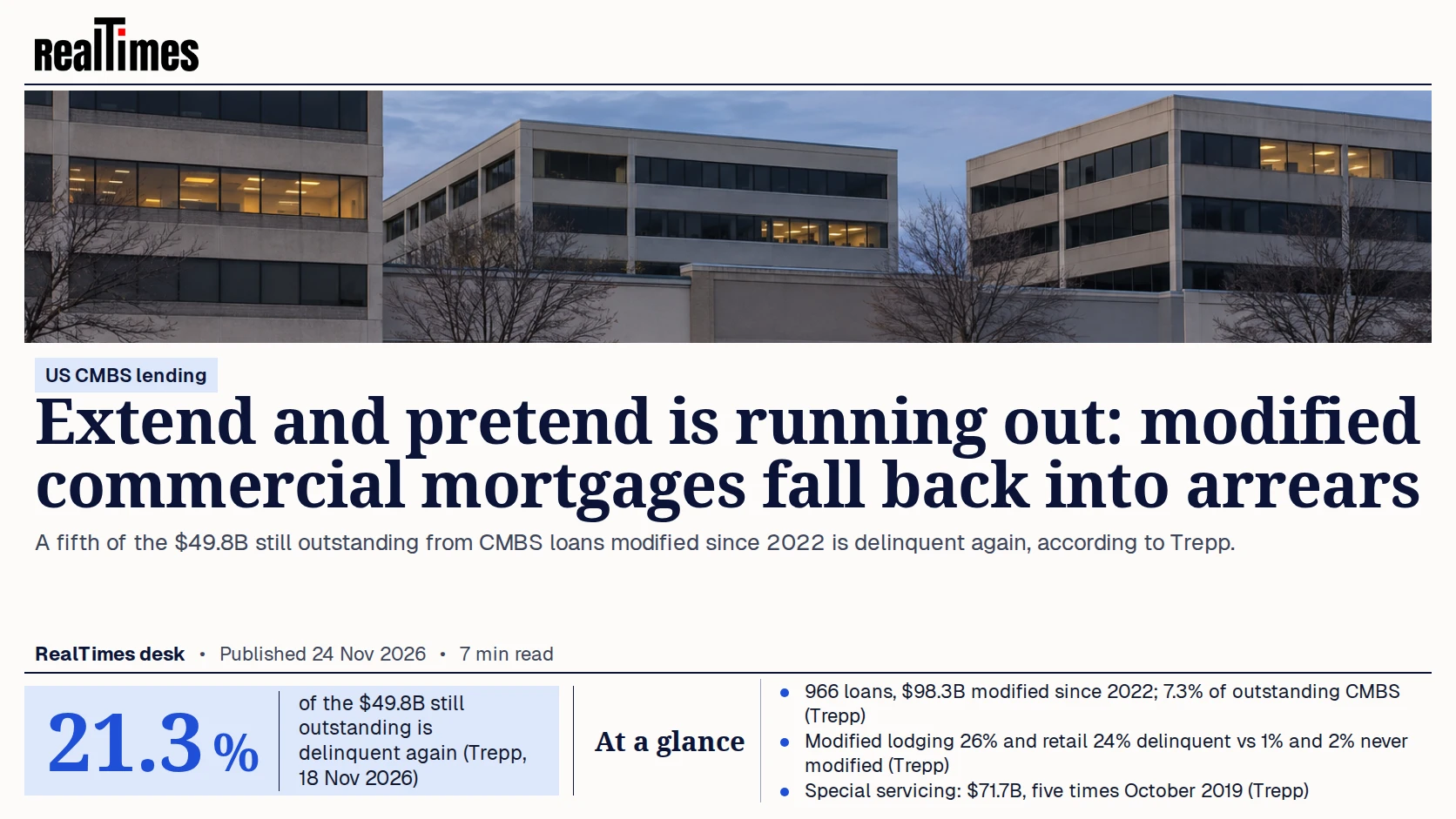
- Servicers have modified 966 US CMBS loans with a combined $98.3B balance since 2022, and 21.3% of the $49.8B still outstanding is delinquent, against 4.7% for loans never modified (Trepp, Bisnow).
- Modified retail loans are 24% delinquent and modified lodging loans 26%, against 2% and 1% for never-modified loans; modified office is at 19% against 10%, and mixed use at 43% (Trepp).
- One in five loans modified in 2024 was back with a special servicer within a year, more than double the 9% rate for 2022 (Trepp).
- Special servicers now resolve more balance through foreclosure (23% in 2026 to October) than the 17% of 2025, while modifications fell to 37% from 49% (Trepp).
For three years the standard answer to a commercial mortgage that could not refinance was more time. The latest Trepp data on US commercial mortgage-backed securities (CMBS) show what that time bought: one in five dollars still outstanding from those modifications is delinquent again.
How much CMBS debt has been modified, and how much has gone bad again?
Since January 2022, servicers have modified 966 CMBS loans with $98.3B of balance, according to Trepp's analysis of November 18. Loans modified since 2022 now make up 7.3% of the outstanding CMBS balance, up from 1.3% at the end of 2022. The busiest year was 2025, with 281 loans and $28.4B; 2026 has added 141 loans and $17.4B through October, a pace that points to fewer modifications than last year.
Of the $49.8B of loans modified since 2022 and still outstanding, 21.3% is delinquent, more than four times the 4.7% rate for loans never modified (Trepp). About 41% of that balance sits with a special servicer. Bisnow, which reported the figures on 20 November, and CRE Daily both carry the same numbers.
The pandemic generation has not cleared. Of the modifications since 2022, 26% went to loans already modified during Covid, and the Covid-era loans that remain show nearly a third of their balance delinquent, with 47% in special servicing (Trepp).
Which property types show the highest delinquency among modified loans?
The gap between modified and never-modified loans is widest outside office. Modified retail loans are 24% delinquent against 2% for retail never modified, and lodging shows 26% against 1% (Trepp). Office is weak either way: 19% of modified balance is delinquent against 10% of office that was never modified. Mixed use is the worst major type at 43%.
Delinquency of CMBS loans modified since 2022 versus never modified, by property type
| Property type | Modified since 2022 | Never modified |
|---|---|---|
| Lodging | 26% | 1% |
| Retail | 24% | 2% |
| Office | 19% | 10% |
| Mixed use | 43% | not reported |
Source: Trepp, 18 November 2026. Trepp reports a mixed-use figure for modified loans only.
Office carries the largest weight. It made up 36% of the modified balance since 2022, followed by retail at 21%, while lodging fell from 31% in 2022 to 8% in 2026 (Trepp). Trepp's companion analysis reports that 29% of office workouts (modifications and cures) from 2024 to 2025 were back in special servicing within a year, against 21% in retail and 19% in lodging (Trepp, 17 November). The office special servicing rate has climbed from 3.0% in October 2019 to 16.3%.
Retail is the patient exception in special servicing. Its special servicing rate has risen less than two percentage points since 2022, and nearly half of its specially serviced balance is still current (Trepp).
What did the modifications actually change?
Most modifications buy time. Of those since 2022, 61% extended the maturity, typically by 12 months, and a paydown accompanied 22%, typically 5.4% of the loan balance. No more than 49% included a paydown or higher reserves (Trepp).
Time has not delivered the recovery the extensions were betting on. As of October, $71.7B of CMBS debt is specially serviced, five times the October 2019 level, and 43% of it has been there two years or more (Trepp). Foreclosure now accounts for 23% of resolved balance in 2026 to October, against 17% in 2025, while modifications dropped to 37% from 49%. A foreclosure averages 40 months to resolve, against about 10 for a cure. Excluding payoffs, the share of loans leaving special servicing with a loss is up 78% since 2022, and realized losses through October are already 72% above all of 2022.
Payoffs were 24% of resolved balance this year, up from 11% in 2023 (Trepp). Trepp wrote: "The middle way, a modification that buys time, has lost the most ground since 2024."
What does it mean for investors and for European lenders?
Our reading: for CMBS investors, the question is moving from whether a loan will be extended to how it will be resolved. Trepp reports that servicers are choosing foreclosure more often, and that recoveries are thinner: losses per dollar of balance at transfer are up about a third since 2022 (Trepp). Trepp names the 2024 modification class as the one to watch.
Our reading: for European lenders, the US cohort is a reference case rather than a direct exposure.
Trepp notes that special servicers, which have no capital ratio to protect, still extended loans in large numbers. It reads this as consistent with a Federal Reserve Board study finding that lenders extend to ride out a temporary shock, and the later redefaults and losses as consistent with a New York Fed study finding that extensions store up losses for later (Trepp).
Why it matters
Our view: the extension era is turning into a resolution era. If rates do not fall before the next round of maturities, then the 2024 modification class, of which one in five is already back with a special servicer, is, in Trepp's words, the one to watch. In office, 29% of 2024 to 2025 workouts returned to special servicing within a year.
If instead rates ease and property values recover, then the 24% payoff share could keep rising. For European lenders and investors watching the US, the signal to track is the ratio of foreclosures to modifications among resolutions, not the headline delinquency rate.
FAQ
What is "extend and pretend"?
Trepp describes extending loans as a bet that rates would fall before the new maturity. Its data show 61% of modifications since 2022 extended the maturity, typically by 12 months (Trepp).
How much modified CMBS debt is delinquent?
21.3% of the $49.8B of loans modified since 2022 and still outstanding, against 4.7% for loans never modified (Trepp).
Which sectors show the widest gap between modified and never-modified loans?
Lodging, at 26% against 1%, and retail, at 24% against 2% (Trepp).
How much CMBS debt is in special servicing?
$71.7B as of October 2026, five times the October 2019 level (Trepp).
Sources (4)
- Trepp, "Modified, Not Fixed: The State of CMBS Loan Modifications", 18 November 2026
- Trepp, "Failed CMBS Workouts Rise as the Extend-and-Pretend Bill Comes Due", 17 November 2026
- Bisnow, "20% Of Modified CMBS Loans Are Ending Up Delinquent Again", 20 November 2026
- CRE Daily, "CMBS Modifications Top $98B, but 21% Are Delinquent Again", 19 November 2026