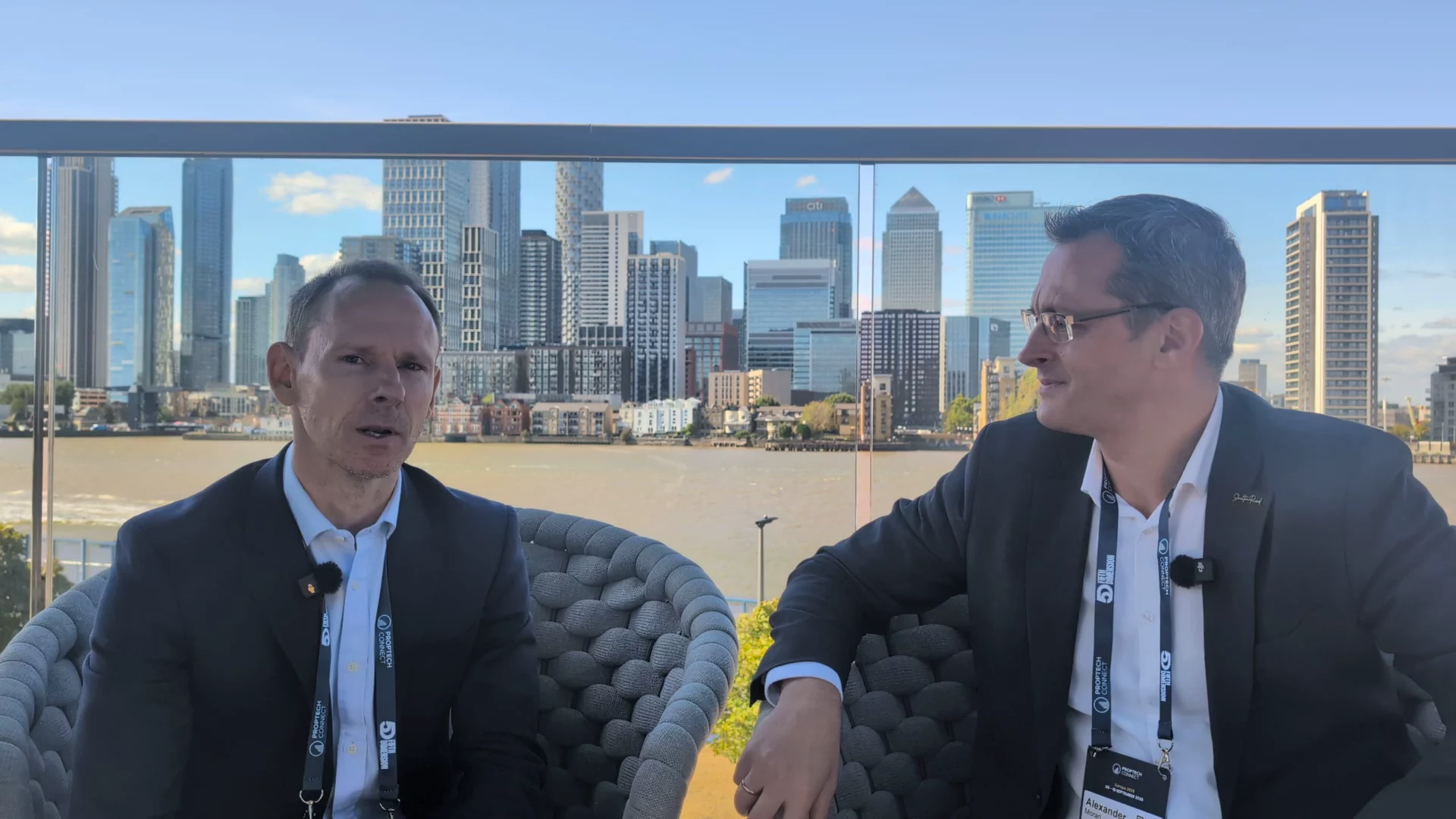
Thomas Kaechele runs Germany and CEE for M&G Real Estate, a role he said he has held for about fourteen years. He spoke with Alexander Morari, MRICS, CEO of Shelton Reed, on the second day of PropTech Connect Europe 2026 at the InterContinental London, The O2, for just over fifteen minutes.
Key takeaway: technology is welcome only where it pans out in the rent, anything genuinely operational needs an operator rather than an investor, and the asset class everyone was talking about is one he is very careful about.
What the room was saying
Asked for the main takeaways from the discussions, Kaechele answered in two words, then qualified them.
Well, it’s AI and it’s tech. Thomas Kaechele, M&G Real Estate
Not surprising in that building, he said, and he counts himself a fan. People want properties moved into the twenty-first century, with more technology so the data exists and more AI to make life easier. His qualification was a cost one. Technology is not for every property, because once it enters the capital expenditure programme it costs money, and that cost is the same whatever rent the asset can ask. It has to pan out and create value for the investors, he said.
Operational, but somebody else operates it
Morari put a broader proposition: that buying with cheap leverage and waiting for appreciation has stopped being a rule, and that an office is now a product whose owner has to be part hospitality professional, part technology professional and part utility provider.
Kaechele agreed with the direction and declined the whole of it. Usage and expectations have changed, he said, but on offices being operational he would tend to not fully agree. Where he was fully with Morari was the newer asset classes: serviced apartments, student housing, senior living. Those are operational, and most real estate investors cannot cover the services themselves. So the expertise gets bought in, or the property is leased to an operator who runs it and pays rent.
Beds and sheds, and a careful no
On allocation he was quick, and unoriginal by his own account, since M&G is not alone in this. Beds and sheds: well located modern logistics, and almost everything that holds a bed, hotels, serviced apartments, ordinary residential, senior living. All of it sits in the portfolio already.
The caution came on the asset class the event was loudest about.
I’m still doubtful, to a certain extent, if this is something for real estate investors on the long run, or if this is more something for the operators, because it’s the shell, and what’s happening inside is the more expensive part, and, to a certain extent, also a cluster risk and a bet on the future. Thomas Kaechele, M&G Real Estate
That is not a call against data centres themselves, he said. Nobody doubts they are needed. His question is what they look like in five years, and in ten.
Why the shell is the cheap part
Pressed on whether a five or ten year old facility already looks different, he said already outdated. The chips change, which changes rack capacity, which changes the cooling from air to liquid and pushes towards modular construction so capacity can be added. Buying the right one, he said, is the million dollar question.
As it is rather expensive, I think it’s not for real estate investors. It’s a land bank game, because at the end of the day, you need land with sufficient energy. That’s the magic around it. Thomas Kaechele, M&G Real Estate
Morari argued the reverse order, that energy is the scarce half and land the easier one. Kaechele said the two usually arrive together, on former power plant sites and production facilities, which makes good brownfield. But the operators want the land and do not need a real estate investor to build on it: a hyperscaler can hire a developer, or use an in-house project management team.
He pointed at London. Data centres in the UK, he said, are not ageing well, unlike a good wine, and are now being retrofitted: good land, good shell, outdated technology inside, and capital programmes large enough that demolition is sometimes cheaper than repair. The shell itself, on his figure, is something in the order of five to ten per cent of the whole data centre, with the rest going to the likes of Nvidia. M&G has an insurance background, he said, and manages client money, so there is no room for high return, high risk investing from the hip.
Year end, and the glass
Asked how the year closes, he called it the million dollar question again, then answered with a pattern. In recent years there has always been a surprise around MIPIM: COVID first, then war in Ukraine, an interest rate crisis, Liberation Day, war against Iran. Who sees what comes next year, he said.
I’m always optimistic, and I always see the glass half full rather than half empty, but you never know, and therefore you have to be vigilant, you have to be prudent in your investment decisions. Thomas Kaechele, M&G Real Estate
The homework gets done before the money moves, he said. On that basis, a bit of room for optimism, which can be scaled if you try hard.
Watch the interview.