



TL;DR
- Serbia, a non-EU state, built Europe's deepest economic relationship with the Emirates: Air Serbia (created via Etihad's 2013 stake, now fully Serbian-owned), the €12bn-plus Belgrade Waterfront (Eagle Hills) and a bilateral trade pact, the CEPA, in force since 1 June 2025.
- The core tool behind Serbia's model, its own trade agreement with the UAE, is unavailable to Poland and the region: trade policy is an exclusive EU competence, so a member state cannot strike a standalone pact with Abu Dhabi.
- CEE's advantage inside the EU is not a bilateral deal but access to a single market of 450 million consumers; a different, harder, but larger pitch to Gulf capital.
Marko Čadež is not one of the developers exhibiting at the IPS 2026 in Dubai. As President of the Chamber of Commerce and Industry of Serbia (CCIS), a post he has held since January 2015, he represents an economy that spent a decade doing what Central Europe is only starting to discuss: systematically converting Gulf capital into hard assets.
What Serbia built
The list of Emirati investments in Serbia is specific, not hypothetical:
- Aviation. In 2013, Etihad acquired a 49% stake in national carrier JAT and restructured it as Air Serbia; its holding gradually shrank until Etihad sold its final remaining shares in November 2023, making the airline fully state-owned.
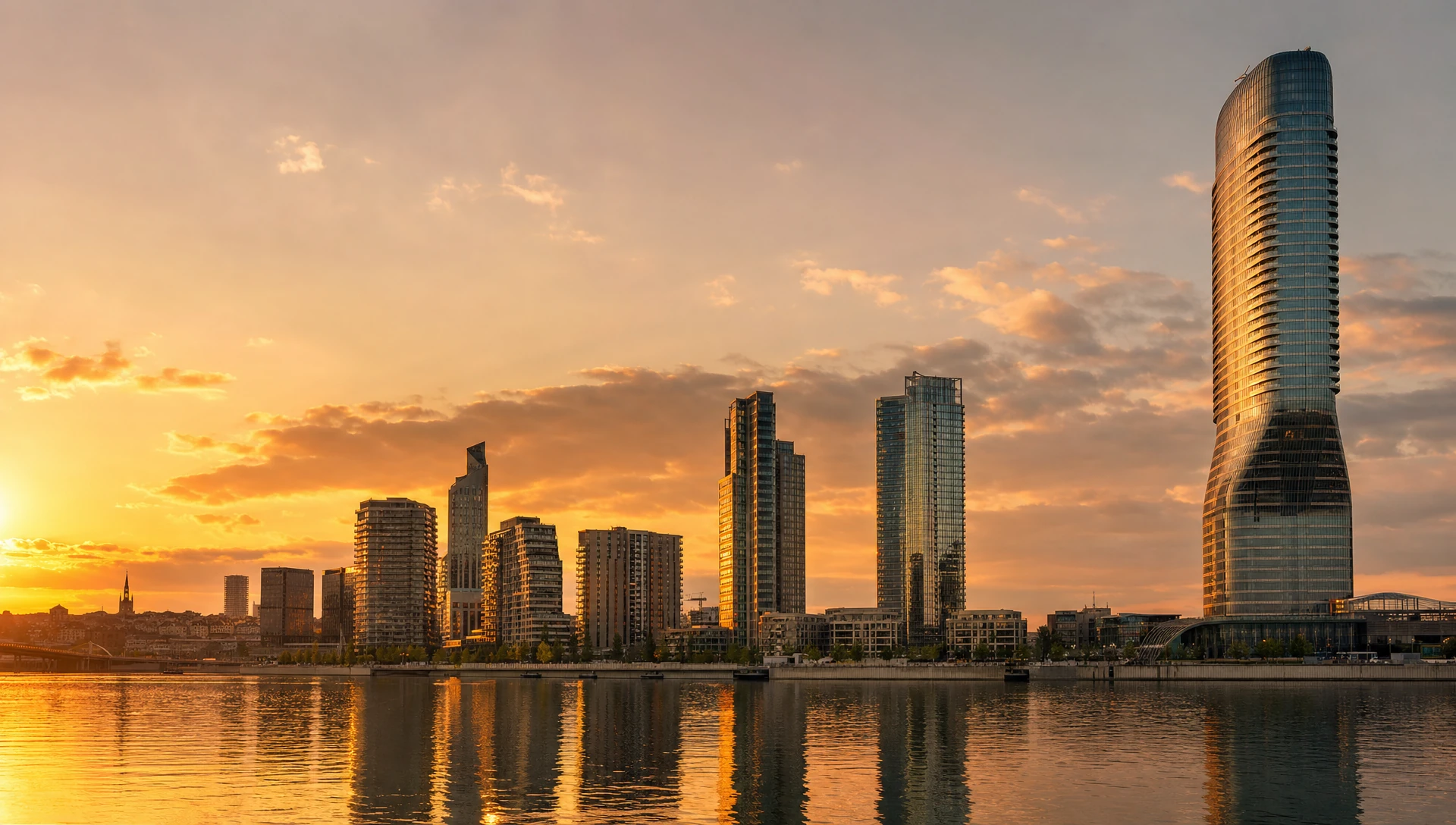
- Real estate. Since 2015, Abu Dhabi's Eagle Hills has financed and built the Belgrade Waterfront on the Sava river; across all phases the project's total value now exceeds €12bn.
- Agriculture. Emirati firms Al Dahra and Al Rawafed entered Serbian agriculture as early as 2013 and 2014.
The macro data confirms the scale. Across 2010 to 2019, the UAE was Serbia's fourth-largest foreign investor, behind only the EU, Russia and China, according to the Arab Gulf States Institute. The capstone is the CEPA, signed on 5 October 2024 and in force since 1 June 2025, eliminating or reducing duties on more than 96% of tariff lines. It is the first CEPA the UAE has concluded with a country outside the World Trade Organisation.
Openness, rapid adaptation, and flexibility are key responses to profound changes in the global economy and the only way for countries and companies to remain competitive.
Marko Čadež, President, Chamber of Commerce and Industry of Serbia (at GLOBSEC 2026)
The tool Poland does not have
Here sits the least obvious point. Serbia could sign its own bilateral trade deal with the UAE precisely because it remains outside the EU. For a member state, trade policy is an exclusive Union competence. Poland, the Czech Republic or Romania cannot conclude a standalone tariff pact with Abu Dhabi, because that power sits in Brussels, where the EU and the UAE are running their own bloc-level CEPA talks.
Serbia's playbook therefore rested on three levers at once:
- Personal relationships at the top of government
- Land contributed into joint projects
- The flexibility of a candidate country
The first two are repeatable across the region. The third disappears on the day of EU accession.
The larger game
Losing the bilateral tool does not mean a weaker hand, only a different offer. Serbia sold Gulf capital land and speed. Central Europe inside the EU sells something Serbia cannot: predictable access to a single market of 450 million consumers, a rule-of-law framework, and gateway status to the whole Union. For an Abu Dhabi fund seeking European exposure, that is a stronger argument than any single tariff schedule. The question this model poses to the region is whether Central Europe can sell that advantage as decisively as Serbia sold its own.