




TL;DR
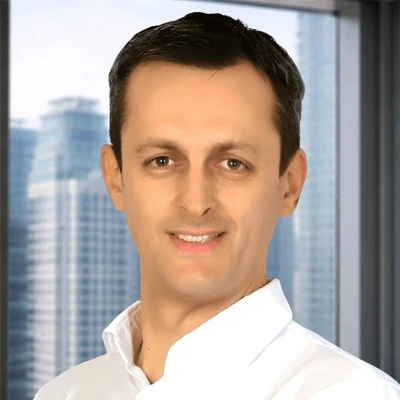
- Alexander Morari, MRICS, CEO of Shelton Reed, is at IPS 2026 to place Middle East capital into European off-market real estate.
- The vehicle is portfolio deals and Separately Managed Accounts (SMAs), deployed across the full asset spectrum on a pan-European basis, not a single-country play.
- Every mandate runs `P<SR>P`, Principal to Shelton Reed to Principal, which shortens the chain between the capital and the decision that puts it to work.
Why Dubai, why now
Q: Why are you at IPS 2026 in Dubai?
Dubai is where Gulf capital is actively looking for a home outside the region, and European real estate is one of the destinations it wants. Shelton Reed's mandate is placing that capital into European off-market opportunities, so IPS 2026 is the room where both sides of that trade actually meet. That is the same Dubai & Europe capital bridge this edition tracks across markets.
The structure: portfolio deals and SMAs
Q: Where in Europe is that capital going, and through what structure?
Through two structures: portfolio deals and Separately Managed Accounts, or SMAs, a single investor's own segregated account run to its own mandate rather than pooled into a fund. Both are used across the full asset spectrum, and both are built to work anywhere in Europe rather than inside one national market. That is deliberate. A Gulf allocator opening a European account wants breadth, not a single-country bet.
`P<SR>P` in practice
Q: Shelton Reed runs every mandate `P<SR>P`. What does that change for a Gulf investor?
Take a mega data-centre deal we worked on in Europe. The project needed a grid connection before a bank would take the financing seriously, and the utility controlling that connection was effectively a semi-monopolist gatekeeper. Under `P<SR>P`, Principal to Shelton Reed to Principal, we brought that utility into the deal directly instead of routing the request through several layers of advisers. Once the connection was secured, bank appetite to finance the project followed it. That is what the model is for: fewer intermediaries between the party that can say yes and the party that needs the yes.
Trust and track record
Q: Shelton Reed is a young firm. Why should a Gulf allocator trust it with a mandate this size?
In practice it is several institutionally distinct allocators, each running patient, structured mandates, often through co-investment or a separate account, wearing the same regional headline.
Alexander Morari, MRICS, CEO, Shelton Reed
Young on paper, and a false startup in substance. The person running it carries close to two decades of experience across European jurisdictions, plus experience in Asia and 360-degree exposure across the asset spectrum. I am MRICS chartered, and the operating principle is simple: treat a partner's business as our own. We spent the build-up gathering capability, drive and reach rather than chasing headlines, and we are now ready to put that to work. We are not claiming to be bigger than we are. We are claiming to be ready.
Two blind spots
Q: What do Europe & the Gulf each get wrong about each other?
Two blind spots, and they run in opposite directions.
- What Europe gets wrong about Gulf capital.
It treats Gulf capital as one homogenous, opportunistic pool chasing trophy assets. In practice it is several institutionally distinct allocators, each running patient, structured mandates, often through co-investment or a separate account, wearing the same regional headline.
- What the Gulf gets wrong about Europe.
It reads the EU single market as one execution playbook. A genuinely pan-European mandate crosses dozens of land-registry systems, tax regimes and legal traditions, so the same asset class needs different structuring in Germany, Poland or Spain. Europe looks like one market on a map and behaves like a dozen the moment you try to close a deal in it.
How to engage
Q: So how does a Gulf allocator actually engage with Shelton Reed?
Through an SMA. It is the vehicle that lets a Gulf allocator open a European account on its own mandate, its own governance and its own pace, rather than buying into someone else's fund terms. We are already structuring around that kind of appetite, and the honest answer to how large an account we are built to run is: large enough that the right conversation is worth having directly, rather than through a headline number. If you are a Gulf allocator thinking about a European off-market program, that conversation is the one to start with Shelton Reed. How that financing structure works across the region is set out in Financing the bridge.
What Dubai is signalling
Q: What is Dubai showing the rest of the market this week?
Watch what Dubai is doing with blockchain, because tokenisation on its own is not the interesting part. The real unlock is using blockchain and smart contracts to change how public & private stakeholders interact, which can unblock developments and investment more broadly. Dubai is already showing this live rather than in theory. The Dubai Land Department issued the world's first blockchain-backed Property Token Ownership Certificate, and the debut listing was oversubscribed. Separately, the VARA virtual-asset framework is now integrated with DLD title registration, giving tokenised property a government-recognised legal pathway where a public registry and private issuers actually meet. The fuller mechanics are set out in Tokenized property ownership. That is a public authority and private capital transacting on the same rail. Europe should be watching that as closely as it watches the capital itself.