



TL;DR
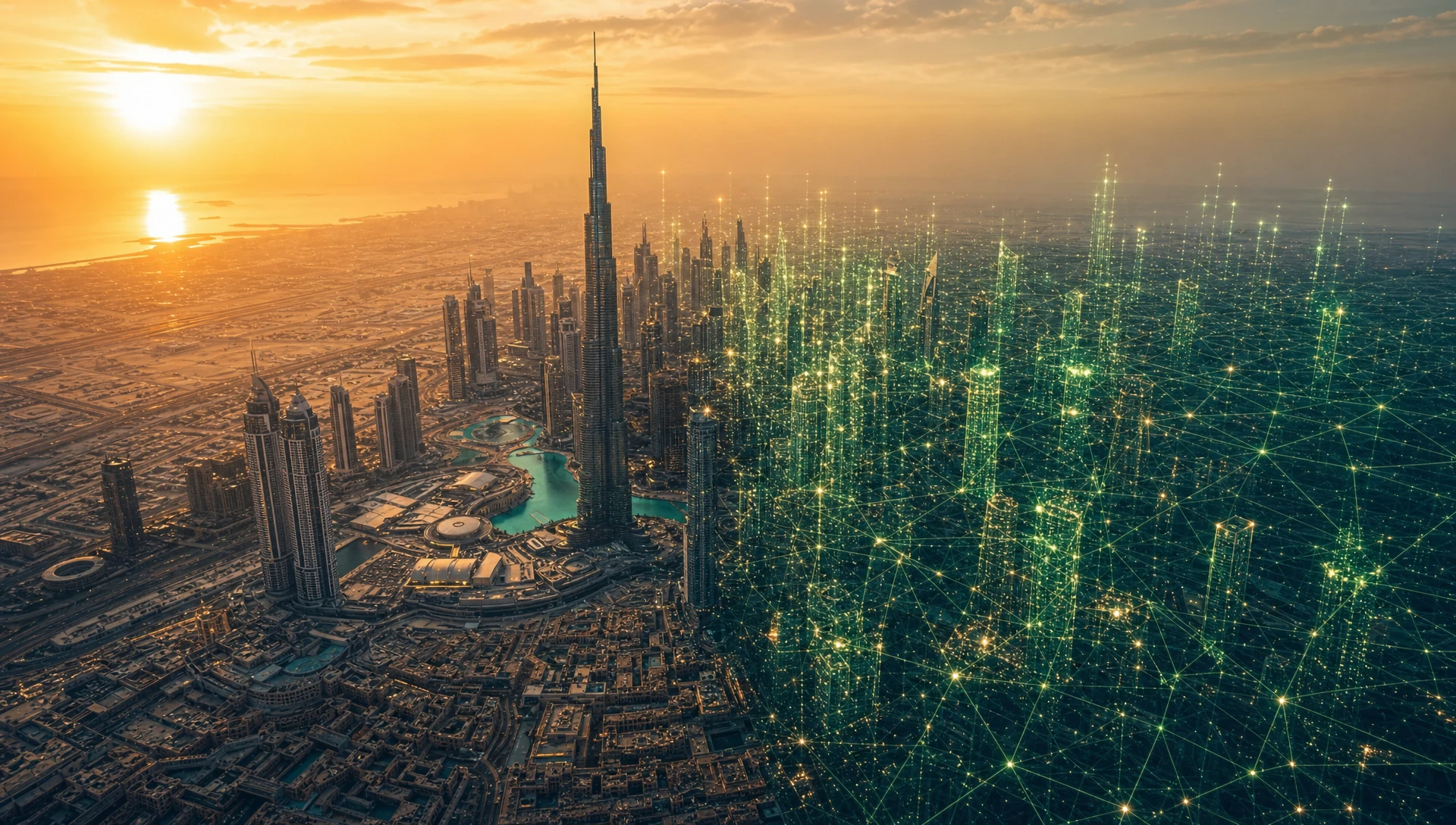
- Dubai is digitising real estate on two fronts at once: the ownership layer, through the Dubai Land Department's tokenisation pilot and the Dubai REST platform, and the physical city, through Dubai Municipality's AED 4 billion greening roadmap.
- The Dubai PropTech Hub, launched by DIFC Innovation Hub with DLD, aims to back more than 200 startups and attract over USD 300 million by 2030, opening the market to green-tech and proptech from outside the Gulf.
- IPS 2026 (7-9 September, Dubai World Trade Centre), where DLD is the strategic partner, is where a European "digital forest" lens on that convergence meets the market building it.
Two quiet revolutions run in parallel in Dubai, and they rarely appear in the same sentence. One is digitising who owns the city. The other is rebuilding the physical city around greenery and public space. Read together, they describe a market moving toward something you might call digital property in a green city, and that is the frontier a European proptech lens finds most interesting. The mechanics of that same tokenisation pilot are unpacked in Tokenised property ownership elsewhere in this edition.
The ownership layer goes digital
In March 2025 the Dubai Land Department launched the pilot phase of its Real Estate Tokenisation Project, becoming the first registry in the Middle East to apply tokenisation to title deeds. It was run with the Virtual Assets Regulatory Authority, the Dubai Future Foundation and the Central Bank of the UAE. Shares can be bought from AED 2,000 (about EUR 500), settled in dirhams, through the Prypco Mint platform. Since 2018 DLD has also run Dubai REST, a digital platform consolidating registry services. The stated ambition is for tokenised assets to reach 7 percent of the market by 2033, about AED 60 billion.
Dubai Municipality is advancing a flexible, inclusive, and long-term urban model that positions beaches, parks, and public spaces as integrated infrastructure assets, making Dubai more vibrant, attractive, and liveable for all.
Marwan Ahmed bin Ghalita, Director General, Dubai Municipality
The physical city goes green
The second layer is concrete, literally. In 2024 Dubai Municipality planted 216,500 trees, a 17 percent year-on-year increase, roughly 600 a day, expanding green space by 391.5 hectares. In February 2026, at the World Governments Summit, it launched the 2030 Blue and Green Spaces Roadmap, a portfolio worth more than AED 4 billion: about 1.5 million trees over five years, 120 new parks across nearly 3 million square metres, and 200 sports and recreational spaces. The roadmap aligns with the Dubai 2040 Urban Master Plan, under which nature reserves and rural areas are set to make up 60 percent of the emirate.
Where a European lens fits
The two layers meet in proptech. In July 2025 the DIFC Innovation Hub and DLD launched the Dubai PropTech Hub, the region's first, targeting support for more than 200 startups and scale-ups, over 3,000 jobs and more than USD 300 million in investment by 2030. It is an open invitation to technology from outside the Gulf, and green-tech sits squarely inside its remit.
Dubai is digitising two things at once: the ownership of the city, and the fabric of the city itself.
This is where a European vantage point becomes useful. European proptech has spent years on a question Dubai's twin programmes raise directly: once a city plants at this scale, how do residents connect to it? RealTimes has examined that gap through its own "digital forest" thesis, a concept that asks how a digital engagement layer, letting people follow, understand and adopt specific urban trees, might sit on top of a physical greening programme rather than beside it. It is an editorial lens, not a Dubai venture, and the point is the pattern: the same instinct that turns a title deed into a token can turn a planted tree into something a resident tracks.
RealTimes brings that lens to Dubai as media partner of IPS 2026 (7-9 September, Dubai World Trade Centre), whose strategic partner is the Dubai Land Department. What interests us is not any single platform but the convergence itself: a city digitising its ownership records and its green cover at the same time, and what that combination makes possible. The registry behind that convergence is profiled in this edition's interview, Majid Al Marri, Dubai Land Department, and the same show's sponsor roster is mapped in IPS partners to watch.