
TL;DR
- Europe holds 5 of the world's 100 tallest buildings, unchanged again in 2025, against Asia's 62. The continent's tall-building story is not a volume story.
- The arbiter of what counts as tall renamed itself in October 2025, from the Council on Tall Buildings and Urban Habitat to the Council on Vertical Urbanism. Its criteria did not change. Its own pages now disagree on the supertall count.
- 3 September is Louis Sullivan's birthday and nothing more. No organisation founded the day, and none owns it.
The world completed 2,593 buildings of 200 metres or taller through the end of 2025, and 255 supertalls of 300 metres or more, according to the Council on Vertical Urbanism's 2026 Trends & Forecasts report published on 9 February 2026. Europe holds five of the world's hundred tallest. That number has not moved in a year. A European platform marking Skyscraper Day is therefore not celebrating a scoreboard it loses. It is marking the one market where every metre has to be argued for.
By the numbers
- 5of 100Europe's share of the world's 100 tallestunchanged in 2025; Asia holds 62CVU 2026 Trends & Forecasts
- 2,593buildingsCompleted worldwide at 200 m or tallerthrough end-2025, double the 2017 totalCVU 2026 Trends & Forecasts
- 255supertallsCompleted at 300 m or tallerCVU's criteria page still states 173CVU 2026 Trends & Forecasts
- 50mUsual threshold for a tall buildingor 14 storeys, judged against contextCVU Tall Building Criteria
- 310mVarso Tower, Warsaw53 floors; owner calls it the tallest building in the EUVarso Place
- 306mThe Shard, to architectural topcommonly cited at 309.6 m measured to tipCVU Skyscraper Center
The date is one man's birthday, and nothing else
Louis Henry Sullivan was born in Boston on 3 September 1856 and died in Chicago on 14 April 1924. With Dankmar Adler he produced more than a hundred works between 1879 and 1895, and Frank Lloyd Wright apprenticed under him for six years.
His claim on the skyscraper rests on an essay, not a tower. "The Tall Office Building Artistically Considered" ran in Lippincott's Magazine in March 1896. It asks what the chief characteristic of the tall office building is, answers "it is lofty", and carries the line that outlived him: "form ever follows function, and this is the law." Both phrases sit in the original scanned issue, seven pages apart.
A century and a half of height
Fifteen buildings that moved the ceiling, 1885 to 2023. Architectural height, metres.
- Home Insurance Building, Chicago, 1885: 42.1 m, 10 floors (Steel-frame skeleton; demolished 1931). source
- Woolworth Building, New York City, 1913: 241 m, 58 floors (The tower as corporate advertising). source
- Empire State Building, New York City, 1931: 381 m, 102 floors (Held the world title for forty years). source
- Torre Velasca, Milan, 1958: 106 m, 26 floors (Postwar Europe answers the American tower). source
- Tour Montparnasse, Paris, 1973: 209 m, 58 floors (So unloved it froze Paris height rules). source
- Willis Tower, Chicago, 1974: 442 m, 108 floors (Bundled-tube structure, tallest until 1998). source
- MesseTurm, Frankfurt, 1990: 257 m, 64 floors (Europe's tallest for seven years). source
- Commerzbank Tower, Frankfurt, 1997: 259 m, 56 floors (First naturally ventilated tower at this height). source
- Petronas Twin Tower 1, Kuala Lumpur, 1998: 452 m, 88 floors (The world title leaves North America). source
- Taipei 101, Taipei, 2004: 508 m, 101 floors (Tuned mass damper as a public attraction). source
- Burj Khalifa, Dubai, 2010: 828 m, 163 floors (Buttressed core; still the tallest ever built). source
- The Shard, London, 2013: 306 m, 73 floors (London accepts a tower over a transport hub). source
- Lakhta Center, St. Petersburg, 2019: 462 m, 87 floors (Europe's tallest completed building). source
- Varso Tower, Warsaw, 2022: 310 m, 53 floors (Tallest in the European Union, spire included). source
- Menara Merdeka Maybank, Kuala Lumpur, 2023: 678.9 m, 118 floors (Second tallest ever; known as Merdeka 118). source
Heights and completion years: the Skyscraper Center (Council on Vertical Urbanism), except the Home Insurance Building, from the Chicago Architecture Center.
The observance has no founder, no sponsoring body and no official status. It circulates as Skyscraper Day, National Skyscraper Day and World Skyscraper Day, and calendar sites list it as observed in the United States, Canada, Hong Kong and the United Arab Emirates. In practice architects, engineers and the tall-building press keep it. That absence of ownership is the useful part. The day belongs to whoever has something to say on it.
The arbiter renamed itself, and its own numbers now disagree
On 6 October 2025 the Council on Tall Buildings and Urban Habitat, founded in Chicago in 1969, announced its transformation into the Council on Vertical Urbanism. The rename was unveiled at the council's annual conference in Toronto, titled "From the Ground Up: Tall Buildings and City-Making". CVU describes itself as "the leading global nonprofit dedicated to advancing tall buildings and responsible density in cities worldwide", and names four tenets: verticality, sustainability, livability and innovation. Its chief executive framed the change as continuity rather than rupture, calling vertical urbanism "a logical extension" of the organisation's past.
Read commercially, the rename moves the centre of gravity from the object to the density. Height becomes one instrument among four. For European developers, who rarely win a consent on height alone, that is the argument they were already making.
The measurement rules did not change. A building of 14 or more storeys, or above 50 metres, is the usual threshold for "tall". Supertall is 300 metres, megatall is 600 metres. Height runs from the lowest significant open-air pedestrian entrance to the architectural top, spires counted, antennae and signage excluded. CVU also recognises two further measures, height to highest occupied floor and height to tip, which is where published figures start to diverge.
What is the chief characteristic of the tall office building? And at once we answer, it is lofty.
Louis Sullivan, Lippincott's Magazine, 1896
Two things on CVU's own site are worth flagging. Its Tall Building Criteria page states 173 completed supertalls, while the February 2026 data report states 255. Prefer the dated report. The same criteria page opens under the CVU name and then reverts to CTBUH in the body, eleven months after the rebrand. The definitional authority has not finished migrating its own definitions.
Europe's five buildings, and why the count misleads
Warsaw ranks 5th tallest city in Europe by count of completed 150-metre buildings, and 99th in the world. London ranks 3rd in Europe and 43rd globally. Those are modest positions, and they understate the stakes, because the criteria carry a context clause: a 14-storey building is unremarkable in Chicago or Hong Kong but, in CVU's own words, "distinctly taller than the urban norm" in a provincial European city. A European skyscraper is defined partly by its neighbours. That is why the planning fight over height is fiercer here than the completion statistics suggest, a fight taken apart in height rules, and why the occupier case has to be rebuilt every cycle, as set out in why height still matters.
The measurement point is not academic. CVU lists The Shard at 306 metres to architectural top. Property Week, reporting the rebranding of 1 Undershaft to One London in June 2026, describes that scheme rising to 309.6 metres as "the joint-tallest building in western Europe, alongside The Shard". Same building, two heights, both defensible under different CVU measures. One London was approved in 2025, is designed by Eric Parry Architects, and its developers target a 2028 construction start and 2033 completion.
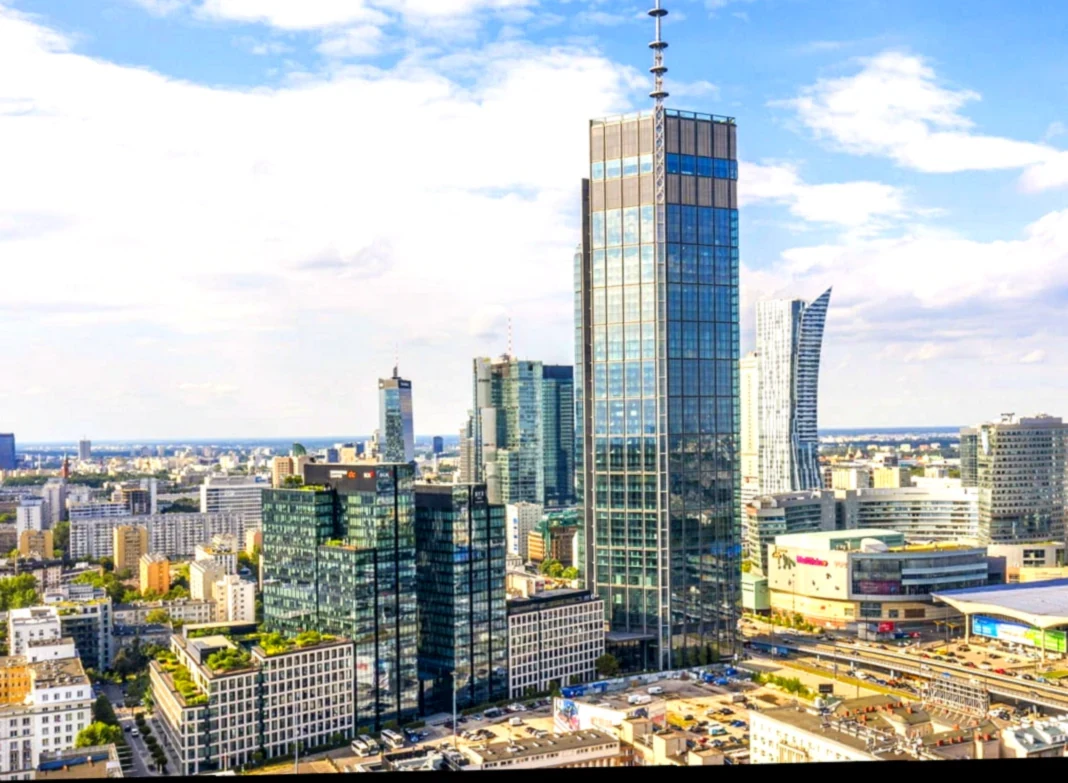
Warsaw's Varso Tower reaches 310 metres over 53 floors, and its owner describes it as the tallest building in the European Union. It sits on top of a rail station, as does The Shard. In Europe, transit adjacency does more consenting work than height ever does. The continent's full stock and pipeline is mapped in Europe's tall-building map 2026 and counted in skyscrapers by numbers 2026.
The year's most telling European completion was not in either capital. Olszynki Park W in Rzeszów, at 220.4 metres and 44 floors, made a Polish city of under 200,000 people the site of one of 2025's new city-record towers. Height in Europe is arriving in secondary cities, not only in the two skylines everyone photographs.
Who gains, who pays
Gains from the CVU reframing:
- Developers arguing density and mixed use rather than a metre count, who now have the standards body's vocabulary on their side.
- Secondary European cities such as Rzeszów, where a 220-metre tower reads as a landmark rather than as an also-ran.
- Transit-linked schemes, where the consenting case was never really about height.
Pays for it:
- Trophy-height positioning, now competing with sustainability and livability inside the same institutional framework.
- Anyone quoting a single height figure without naming the measure, given the 306 and 309.6 metre readings of the same tower.
- Data consumers relying on the criteria page, which still shows a supertall count 82 short of the current report.
Why RealTimes marks it, and what to watch
RealTimes covers Warsaw, London, Amsterdam and Bucharest. Two of those cities hold the argument in physical form, and the pairing is the premise of the Dialogue of Skyscrapers series. Its first edition, at Yes, We Cannes! 2026 Warsaw on 9 April 2026, put Varso Tower & Burj Khalifa in conversation on floors 42 and 43 of Varso Tower itself. The second edition pairs Burj Khalifa & The Shard in London and has moved from its original September date to 2027.
Sullivan asked in 1896 how a building that exists because of land price and the elevator could also be worth looking at. The 2026 version of the question is harder: how a building that exists because of land price and transit also clears a carbon budget and a planning committee.
Two dates to watch. CVU's next Trends & Forecasts report, due around February 2027, will show whether Europe's count holds at five for a third consecutive year, and whether the criteria page has finally been reconciled with the data. And in the fourth quarter of 2027, One London's financing and 2028 start date will test whether the City of London can still deliver a 309.6-metre tower on a schedule set in a different interest-rate world. The rest of the Skyscraper Day Dive takes the question apart city by city.