TL;DR
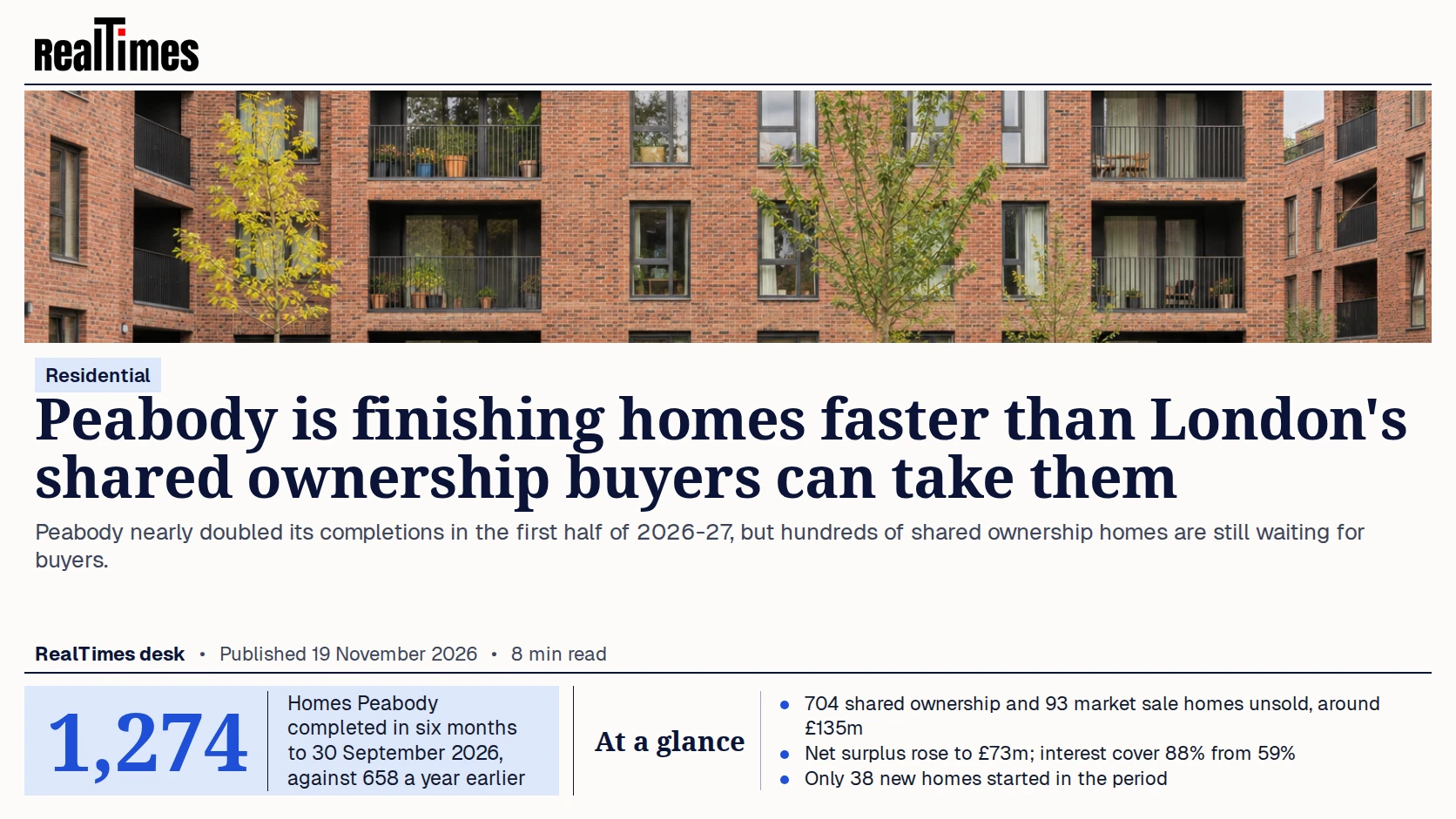
- Peabody completed 1,274 homes in the six months to 30 September 2026, against 658 in the same period a year earlier, and started only 38 new homes (Peabody trading update).
- At the half year it held 93 market sale homes and 704 shared ownership homes unsold, including 263 awaiting release because of snagging issues, with a value of around £135m (Peabody trading update).
- The finances improved: the net surplus rose to £73m and interest cover on the regulator's EBITDA MRI measure to 88% from 59% (Peabody trading update). The weak spot is selling shared ownership homes in London.
Peabody, the G15 landlord with nearly 111,000 homes owned and managed (Peabody trading update), has published a half-year update with two stories in it. On the building site, the numbers have turned sharply up. In the sales office, finished homes are waiting for buyers, most of them shared ownership homes.
How much did Peabody actually build?
A lot more than a year ago. Peabody invested £246m in new homes and completed 1,274 of them (Peabody), against 658 completions in the same six months of 2025 (Peabody trading update). Housing Today called it nearly double, with investment up from £215m.
A further 2,809 homes were under construction at the half year, and Peabody started on site with 38 new homes (Peabody). "Our focus remains on completing our existing development programme while managing investment carefully," the group said.
Why are nearly 800 homes still unsold?
Finishing a home is not the same as selling it. The update lists 93 market sale homes and 704 shared ownership properties unsold, "including 263 properties that are awaiting release due to snagging issues", with a value of around £135m (Peabody trading update). The two categories add up to 797; Inside Housing headlined the figure as nearly 800.
Sales revenue fell by £6m to £42m in the half (Peabody), with a further £48m of sales exchanged or reserved for future completion (Peabody trading update). In Peabody's own table of unsold homes, 376 of the 797 sit in the band of over six months, and 317 of those are still available rather than reserved.
Peabody's unsold homes at the half year (30 September 2026), by age band
Peabody points to London. The sales market "remains challenging, particularly for shared ownership homes in London, where affordability pressures and mortgage costs continue to affect potential buyers" (Peabody trading update). Phil Day, the chief financial officer, said the market for new homes "remains difficult across the sector, particularly for shared ownership" (Housing Today).
Existing shared owners behave differently. Staircasing, where they buy further shares in their homes, generated £46m of income in the half (Inside Housing), more than the £42m of sales revenue.
Is Peabody's balance sheet the problem?
Not on these numbers. Turnover rose by £15m to £537m and the net surplus rose by £18m to £73m (Peabody trading update). Peabody also booked one-off break gains totalling £22m after it began simplifying historic bank borrowing facilities (Housing Today).
Interest cover on the regulator's EBITDA MRI measure improved to 88% from 59% (Housing Today). Peabody says it continues to "comfortably meet lender interest cover requirements, maintaining significant levels of headroom" (Peabody trading update).
The pressure sits in the operating line. The operating surplus fell to £141m from £156m and the operating margin to 26% from 30% (Housing Today). Peabody puts this down to higher spending on responsive and planned maintenance, leaseholder works and communal gas works (Housing Today). Repairs and maintenance alone took £124m, against £104m a year earlier (Inside Housing).
Peabody's half-year in figures
| Measure | Six months to 30 Sep 2026 | Six months to 30 Sep 2025 |
|---|---|---|
| Homes completed | 1,274 | 658 |
| Turnover | £537m | £522m |
| Operating margin | 26% | 30% |
| Overall net surplus | £73m | £55m |
| EBITDA MRI interest cover | 88% | 59% |
Source: Peabody trading update, unaudited.
Is this a Peabody problem or a sector problem?
The regulator's figures point to the sector. Across England, the larger private registered providers, those owning or managing more than 1,000 homes, held 7,877 unsold affordable home ownership units at the end of June 2026, down 1% on the quarter. Yet the number unsold for over six months rose to 3,439, according to the Regulator of Social Housing.
Affordable home ownership sales fell 26% in the quarter to 3,337 units, below the three-year average of 4,255 (the regulator). The margin on them rose to 13.3% but remains at historically low levels, the regulator says.
Policy is moving the other way. The government will raise shared ownership income caps from £80,000 to £90,000 outside London and from £90,000 to £110,000 in the capital, Mortgage Solutions reported. The change follows a written statement to Parliament by housing minister Matthew Pennycook (Mortgage Solutions). Peabody welcomes the proposed increase, which "could help more people buy a home in the future" (Peabody trading update).
Meanwhile, Peabody is working on price and tenure. It is regularly reviewing property values and the initial rents charged on unsold equity, and exploring tenure conversion on certain schemes, Show House reports.
Why it matters
Our view: at Peabody the constraint has moved from the building site to the sales office. Its update shows finances strong enough to carry slow sales for now, and a stock of finished homes that now has to move.
If the higher London income cap of £110,000 widens the pool of buyers, then the 704 unsold shared ownership homes are the first stock that could move. If London sales stay slow, then more of the around £135m tied up in unsold homes waits on reviewed values, adjusted rents or tenure conversion.