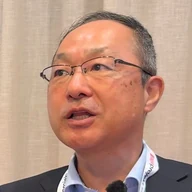
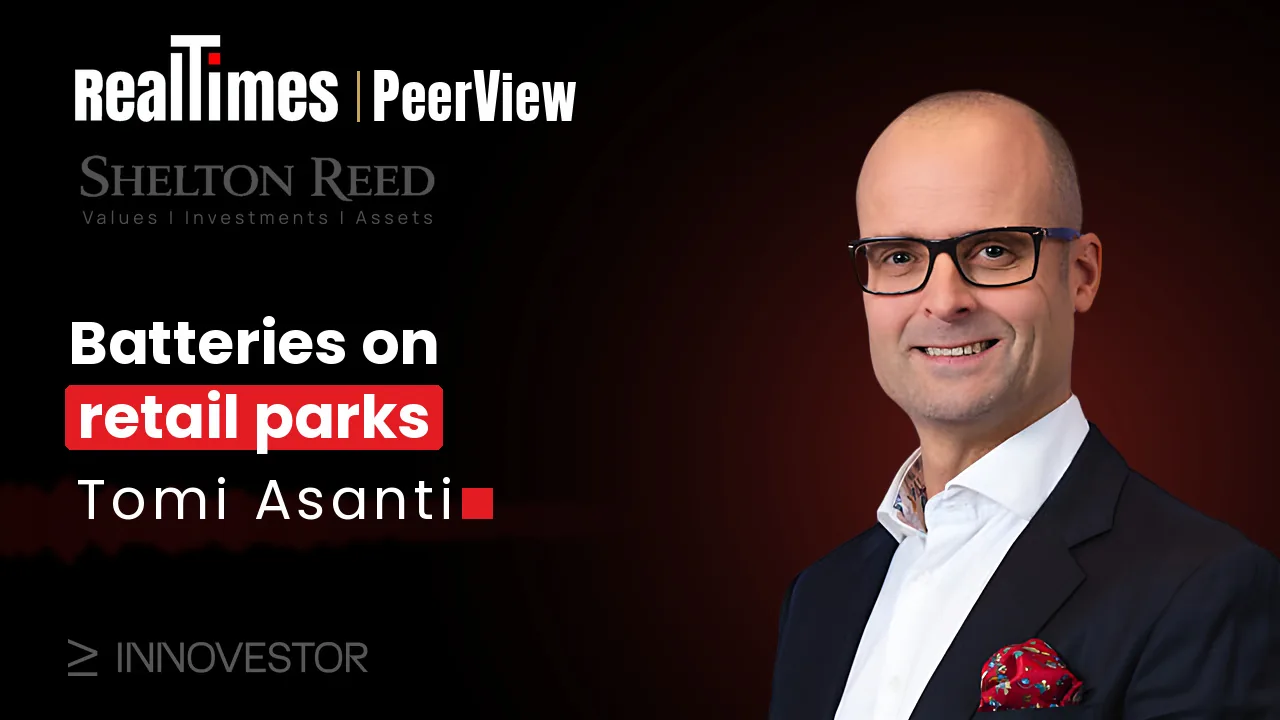
Tsuyoshi Kidera described Tokyo Tatemono as one of the real estate developers in Japan and said his company sits under it, acting as asset manager. He spoke with Alexander Morari, MRICS, CEO of Shelton Reed, at EXPO REAL 2026 for nearly 10 minutes on where the overseas business is heading, which asset classes fit which market, and why a developer stays a developer when it crosses borders.
Key takeaway: Kidera said the company wants to shift from China and East Asia to the US, Australia and London, and that in continental Europe too it would be focusing on development projects or value-added style.
Who is behind the overseas business?
Kidera said the parent company is currently expanding its overseas business, to the US, Australia and the London market [00:40]. His own company, under Tokyo Tatemono, acts as asset manager.
He drew a line between a developer and a financial institution. Because the company is a developer and not an institutional financial institution, he said, the overseas business concentrates on development and on value-added investment [00:40].
Tokyo Tatemono was established in October 1896 by Zenjiro Yasuda, which the company calls the birth of Japan's first modern real estate company. It is listed on the Prime Market of the Tokyo Stock Exchange and reported operating revenue of 474.6 billion yen and total assets of 2.27 trillion yen for FY2025.
Why leave China and East Asia?
In the past the focus was China and East Asia. Kidera said those markets are struggling to make a profit because of political and market issues, so the company wants to shift from such developing countries to developed ones: the US, Australia and London [00:40].
In Europe, he said, the current focus is London, and he gave liquidity as the reason [00:40].
The company's first venture in the United Kingdom is a partnership: it is one of five companies behind the refurbishment of 125 Shaftesbury Avenue in London, an office building completed in 1982. The total project cost is approximately £550 million, with completion targeted for 2028.
Avison Young counted £2.0bn of central London office investment in the second quarter of 2026, a quarter lifted by owner-occupier activity. Savills wrote in March 2026 that Japanese investment in the central London office market started to return in 2025.
Which asset classes fit which market?
Kidera said the answer depends on the country.
So, as for the London market, we prefer the office and the residential.
Tsuyoshi Kidera, Tokyo Tatemono [02:50]
For continental Europe, which he described as a near-term ambition, the preference at this timing is residential or logistics. In Australia he called the BTR a very attractive sector, because it is expanding with the increase of the population [02:50]. Thailand is another focus area, he said, with residential and logistics there too [03:54].
Company documents list residential schemes in Herndon, Virginia and Broomfield, Colorado, and logistics projects in Chonburi and Samut Prakan in Thailand. In Australia the company entered in 2024 with a condominium project in Sydney and in May 2025 joined two strata-titled warehouse projects near Sydney. Real Estate Source reported in September 2026 that it joined a logistics investment vehicle seeded with east coast assets. BDO's 2026 report counts 51,000 build-to-rent apartments operating, under construction or in planning in Australia, with 33 operating platforms.
Why the US, London and Australia?
Morari put it to Kidera that the company seems to prefer Anglo-Saxon markets, and wondered whether the reason is ease of entry or business-friendly regulation [04:31]. Kidera pointed to size.
I think one of the key issues is how big is the real estate market itself.
Tsuyoshi Kidera, Tokyo Tatemono [04:52]
He said he thinks the US is number one, and named London and Australia as well, "in the near future" [04:52].
Cushman & Wakefield data reported by Mingtiandi show Australia overtook the US in 2024 as the biggest recipient of Japanese outbound investment in commercial real estate, with inflows of nearly $1.8 billion.
How much is allocated, and where?
On allocation for 2026 and 2027, Kidera said that for the time being half goes to the US and the other half is split between London and Australia, with other areas such as Thailand also planned [03:54].
On the total volume, he said he could not give the exact amount.
We are discussing with the next mid-term plan coming next year, but we cannot say the exact amount.
Tsuyoshi Kidera, Tokyo Tatemono [05:38]
The company's published figure for the current medium-term plan, FY2025 to FY2027, is 110 billion yen in overseas projects, including condominiums, rental housing, offices and logistics facilities in the US, Australia, Thailand, China and other countries. It aims to generate 10% of its business profit from overseas business by fiscal 2030.
What would continental Europe look like?
Morari raised the question of what would draw the company into continental Europe if it had double the amount to invest [06:19]. Kidera said they have no footprint in Europe at this moment and no representative office, but that they hope to establish one. After that, he said, they want to expand to continental Europe, naming Germany and the Nordics as examples of attractive places [06:50].
He added one point.
Even though we expanded up to the continental Europe, we are definitely focusing on the development project or value-added style as a real estate developer.
Tsuyoshi Kidera, Tokyo Tatemono [06:50]
Can offices be converted, and how does London differ from Japan?
Morari wondered whether the company has experience in converting offices into residential [07:50].
No no right to be honest in Japan is very it's very difficult to do to the strict regulation.
Tsuyoshi Kidera, Tokyo Tatemono [08:00]
He then said "some of them are convert from office into hotel" [08:12], which Morari took to be a little bit easier [08:20].
Morari's last question was how doing real estate business in Japan differs from London [08:23]. Kidera said that in London it may be difficult for the company to develop a certain building by itself, so it needs a local developer every time. In Japan, he said, it can manage by itself [08:41]. Morari read this as holding until the company grows its scale [09:19].
FAQ
What did Kidera say about an office in Europe?
He said they have no footprint in Europe at this moment and no representative office, that they hope to establish one, and that after that they want to expand up to continental Europe [06:50].
Which asset classes does Kidera name for each market?
For London, office and residential [02:50]. For continental Europe, residential or logistics [02:50]. For Australia, the BTR [02:50]. For Thailand, residential and logistics [03:54].
What did Kidera say about the size of the allocation?
He said the company is discussing it with the next mid-term plan coming next year, but that he cannot say the exact amount [05:38]. He said that for the time being half is allocated to the US and the rest is split between London and Australia [03:54].
Watch the PeerView.