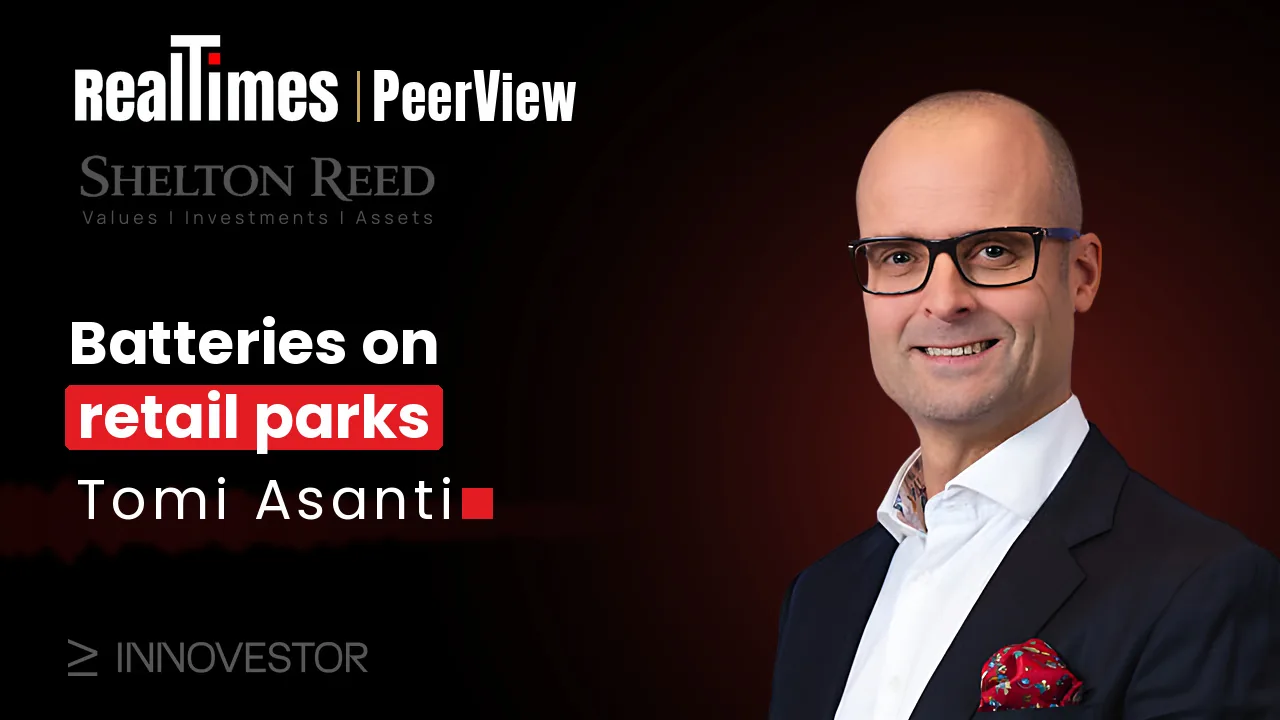
Tom Hagen, Deputy CEO and Head of Transactions at Prisma Properties, explained how a listed Nordic retail owner and developer chooses between building a property and buying one. In a PeerView recorded at EXPO REAL 2026 he spoke with Alexander Morari, MRICS, CEO of Shelton Reed, for about 18 minutes. The conversation ran from the spread that sets the route to Finland as the growth market, then to what leaving Norway taught the platform, and finally to where a retail asset can go wrong.
Key takeaway: Hagen described a test for build or buy: "if the spread between the direct market and the developed market is not wide enough it doesn't make sense to develop" [09:31]. He also said "it's a mix" [09:31], with geographic diversification part of it.
Who is Tom Hagen and what does Prisma Properties do?
Hagen introduced his employer as "a Nordic retail platform" and said the company is listed on the stock exchange in Sweden [00:22]. A company release of 2025-12-01 lists Hagen as Deputy CEO and Head of Transactions.
He said Prisma is both owner and developer of retail properties [01:29], in three segments:
- grocery and daily goods, the biggest, "so supermarkets, so to say" [01:29]
- discount or affordable retail [01:29]
- quick service restaurants combined with fast charging along European motorways, which he called "a little bit of an odd one" [01:29]
Growth is the stated aim: "we are a growth company so we target to grow our platform over the coming years" [00:22].
What is Prisma's position on the cost of capital?
Morari put to him what the CEO most often challenges in an acquisition target [02:44]. Hagen's answer widened into the market itself: "we have relatively higher cost of capital compared to our main competitors in the Nordics" [03:10]. Grocery, he said, "is very hot at the moment", and "we have to have a competitive edge to make it work" [03:10].
Why did Finland become the growth market?
Hagen said the company has been "quite active in Finland" since last year [02:14]. Morari noted that Sweden is competitive and Finland no less so, and put the question of what makes Finnish grocery more attractive [05:48].
Hagen's answer was pricing and financing: "It mainly boils down to the pricing and the cost of capital and the yields in Finland" [06:09]. On risk he drew a line: "we see the same tenants in Finland and in Sweden and we don't assess Finnish grocery retailers to be more risky than Swedish ones" [06:09]. His conclusion: "we make better risk-adjusted returns in Finland and get more cash earnings for our shareholders" [06:09]. Whether that is the right return, he added, "it's in each investor's assessment" [06:09].
By his account the decision to enter came in early Q2 of 2025 [13:12]. The speed came from known tenants: the same brands that are active in Sweden and Denmark are active in Finland, "we know already the brands", and monthly conversations with business developers made it "quite easy to apply that knowledge on the Finnish market" [13:12]. Concepts now travel in both directions, and a tenant who is unhappy in one location is, in his words, "more plug and play and easy to substitute" [13:12]. He kept it balanced: "it's still a give and take" [13:12].
What did Norway teach the platform?
Morari framed a business as a system judged less by whether it makes a mistake than by how it reacts to one [04:21]. Hagen used Norway as the example: "When we entered Norway timing was not right and just after we entered we had the interest rate crisis" [04:46].
The result, he said, was plain: "the cost for our exposure to Norway was simply not worth the gains" [04:46]. The logic of the exit: "it boils down to cost of opportunity" [04:46]. Prisma left Norway at the beginning of this year, he said, and he did not close the door: "Not saying we won't go back to it" [04:46]. For now, "the best markets in the Nordics to make money in my opinion are still Denmark, Sweden and Finland" [04:46].
How does Prisma decide between building and buying?
Morari put a figure to him for some ongoing projects: seven plus [09:11]. Hagen answered "7.3 in the moment" [09:16]. Then Morari put the question of what decides between building and buying [09:18].
Hagen started with "it's a mix", rooted in "it's our belief where we make the best returns" and a wish to "diversify geographically to some extent" [09:31]. Then came the test: "if the spread between the direct market and the developed market is not wide enough it doesn't make sense to develop" [09:31].
Finland is his example of a market where Prisma does not develop, "because we feel that the yield on cost is like too close to the yield in a direct market" [09:31]. The company accepts a little less return there, but "we don't take any development risk" [09:31].
Sweden is the other case. Yields are so tight that, with Prisma's capital structure or capital source, "it's difficult to compete with pension backed platforms" [09:31]. Development opens another route, with "a really nice spread between the direct market and what we can develop" [09:31]. He acknowledged a lag: the development cost has to be invested for a year before it earns cash [09:31].
He also described a possible next step: selling some developed assets and reinvesting "in our development platform or into further acquisitions", which would let the platform grow cash earnings "without needing to raise equity" [09:31]. He was careful about timing: "I'm not saying we're there yet" [09:31]. Should equity become more expensive, "that's a card we can play" [09:31].
What goes wrong with a retail asset?
Morari put the question of what the critical features are when an asset fails [07:18]. Hagen did not use the word failed for the buildings Prisma developed itself: "all of those are doing quite well", so "I wouldn't go at all to the extent and say we had failed properties" [07:31]. Properties bought during the expansion are another matter: "which are maybe less ideal" [07:31].
His answer is a wider diligence team. Already at acquisition, the company looks at a property "not only with our M&A team, but both with our business developers and with our property managers" to ask "can we actually work with these properties" [07:31].
Morari suggested vacancy as the risk to plan for [08:14]. Hagen pointed elsewhere: "a more likely case is more a higher operating costs or higher hidden capex" [08:30]. Because Prisma develops, "we have builders within our company", and "we are usually quite good at assessing costs" [08:30]. When the estimate is wrong, "sometimes we can be off", the consequence is "a compression in the cash earnings for a couple of years" [08:30].
How do energy and the EU EPC reform fit in?
Morari raised batteries and solar as signs of energy resilience in the Nordics and put the question whether scale had brought such synergies [15:19]. Hagen did not see it that way: "I wouldn't call it synergies myself", he said, "I think it's just a natural next step" [15:46]. He said the buildings include solar panels, fast charging and energy efficiency, plus green lease addendums on the legal side [15:46]. The aim, as he put it, is "to have the best buildings possible" [15:46].
Looking ahead, he linked the EU's EPC reform to what he called "another quality stamp on our portfolio" [15:46].
FAQ
Why does Prisma develop in Sweden but not in Finland?
Hagen described it as a mix, with the spread between the direct market and what Prisma can develop as the test. In Finland the yield on cost is "too close to the yield in a direct market", while in Sweden he sees "a really nice spread" [09:31].
What did he say about leaving Norway?
Timing was not right for the entry, the interest rate crisis came just after it, and the cost of the exposure "was simply not worth the gains", so the exit came down to "cost of opportunity" [04:46].
Which risks does he name for a retail asset?
A more likely case, he said, is higher operating costs or higher hidden capex [08:30]. Prisma's in-house builders help it estimate cost, and a miss can compress cash earnings for a couple of years [08:30].
Watch the PeerView.