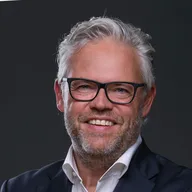
Rainer Nonnengässer, Managing Director of Omniliv, runs a development and management platform for PBSA and micro living in Germany. In a PeerView recorded at EXPO REAL 2026 he discussed with Alexander Morari, MRICS, CEO of Shelton Reed, why a Frankfurt permit came in under three months, how micro living takes pressure off the family rental market, how an office building is screened for conversion, and what the PGM name opens.
Key takeaway: By Nonnengässer's account, how fast a developer can build depends on the municipality. In Frankfurt, he said, the city "granted us a building permit without any limitations in less than three months" [03:12]; in other cities, "you take 12 months or you have back and forth discussion" [04:56].
What does Omniliv build, and where?
Nonnengässer said Omniliv was founded by PGM as a development and management platform, with the idea of "bringing state-of-the-art PBSA and micro living products to the market in Germany" [00:36]. Given the state of the commercial real estate market, the team focuses on "Berlin, Frankfurt, Hamburg and Munich as our target cities" [00:36].
He said the company follows a strong trend, the conversion of office buildings into housing, and described "two projects in delivery and the pipeline of some four to six further projects in these cities" [00:36]. The team tries to secure three to four of those by the end of this year, he said [00:36]. These figures are his own and unverified.
Why does he see a widening gap in the big cities?
Morari put it to him that these are tier one cities with persistent demand, where the company wants to make up for a lack of supply [01:33]. Nonnengässer agreed and set out his reasoning: net positive migration into these cities, and new housing delivery that fell short in recent years because of a changing interest cycle and steadily rising construction costs. The result, he said, is a demand-supply gap that widens year on year [01:47].
How do city politics and red tape shape the business?
Morari raised Germany's reputation for a complex, convoluted administrative decision-making process, and wanted to know where the disconnect between public authorities and business-friendly processes comes from [02:36]. Nonnengässer's answer was that cities differ. In most of the bigger cities, he said, agendas focus on affordability, families and rent caps rather than on stimulating supply, but it is "not the situation in all cities" [03:12].
His example came from his own work. One current project is an office building in Frankfurt. The company approached the municipality, he said, and it was extremely in favor of what the company wanted to do with the building and "granted us a building permit without any limitations in less than three months" [03:12]. In other cities, he said, "you take 12 months or you have back and forth discussion" [04:56].
He cautioned against a one-sided picture: "we need to be careful that the perception is not unilateral all over Germany" [04:56].
Is political risk part of the business, and why does micro living help?
Morari wanted to know whether the business is affected by the political weather in the city where it operates [05:18]. Nonnengässer said there are always risks. Some municipalities, he said, understand that the company brings a product to the market for a specific target group, which takes pressure off the rental market for families. His example: "if I, let's say in Berlin, have 450 micro units, I have 450 potential tenants who would have looked for something different in the family rental market" [05:46].
Morari wondered whether that meant micro living for families as well. Nonnengässer said no: by serving specific target groups with micro living or PBSA, "I'm taking pressure from the multifamily market" [06:32]. Those tenants no longer look for two- or three-bedroom apartments or team up in flat shares, he said.
Municipalities that see this, he said, take it as a win-win, above all when a dead office building gets "a new life", "like a phoenix getting back into the market" [06:32]. Others see it differently. For them, he said, "we are, let's say, the bad guys", because the company builds small apartments and charges high rents [06:32].
What decides whether an office building can become housing?
Morari wanted to know what the biggest expected challenge had been when buying, and what turned out to be the real one [07:52]. Nonnengässer said the major challenge "when you try to convert office to resi is to deal with the existing substance" [08:19]. He then walked through what he checks:
- The floor plan. A typical office building with a rectangular plan and a middle corridor is "perfect for small units on both sides", while some avant-garde octagonal or hexagonal plans leave "a lot of dead space" [08:35]. Plans like that are ditched, he said, because the ratio of gross space to net lettable space is too weak [09:15].
- The technical state. Concrete quality (he said the regulation changed in the early 1990s), asbestos, which he finds more in buildings from the 1980s than after 2000, noise isolation and energy efficiency [09:15].
- The concept. "Our standard concept is to strip back to the concrete skeleton and rebuild from there," so that the result qualifies as a new built building in a technical sense [09:15].
- The underwriting. "Finally you need to make the underwriting work": the cost side in detail, and on the rental side the micro location, the neighborhood, the competition and the achievable rent [09:15].
A conversion, he added, means "way more details to assess in a dd phase than if you just buy a plot for new building", but in most cases it brings "very attractive micro locations", and in light of an embedded life cycle carbon analysis "repositioning of existing stock also has some advantages on the ESG side" [09:15].
What does the PGM name bring?
Morari noted that as a company Omniliv can flex its financial muscle with PGM behind it, and wanted to know how PGM helps it grow [11:17]. Nonnengässer's first answer: "the name PGM is a door opener in all respect" [11:34]. Most of his counterparts are institutional, he said, and all the banks he talks to have had business with PGM in the past. With a municipality it also helps not to be a developer with thin equity: he can say that financing and the project are in place [11:46].
Morari then wanted to know what he thought had decided it for PGM to bring him into the family [12:57]. Nonnengässer said "I cannot speak for PGM themselves", but his assessment is that in some niche segments PGM runs more and more a strategy of keeping management companies under full control "instead of going into joint venture structures", "being in charge of the whole life cycle from planning, development to exit" [13:07]. They do this with Omniliv on the modern living side and also on the logistics side, he said, "and that's quite a successful model" [13:37].
What comes after Germany?
Morari wanted to know the two or three biggest challenges to scaling beyond those already discussed [13:47]. Nonnengässer said that at some point there will be a discussion with PGM on the geographical focus. Today the company is focused on Germany only: "maybe next year or the year after next, we will also look cross-border whether this will be into Italy or into CEE to be discussed" [14:03]. He said he has done business in Poland, Hungary and the Czech Republic in a previous life and likes those countries, and that Italy interests him because the supply-demand ratio is extremely weak there as well [14:03].
Morari came back to the conversion business model [15:04]. Nonnengässer said mature European office markets are under pressure from the EU Green Deal, which takes stock out of the market early in its life cycle, and from the cultural shift to home office and flex office, in France, Italy and Spain as well as in Germany. And Omniliv, he said, is not limited to conversions: it does new build as well [15:07]. Morari closed the conversation by wishing him all the best [16:10].
What does it mean for developers?
The conversation reads less as a forecast than as a developer's checklist. By Nonnengässer's account, permit speed is local: one municipality moved in under three months, while in other cities he sees 12 months or a back and forth of discussion [03:12, 04:56]. A conversion, by his account, is worked out in due diligence, where the existing substance and the underwriting have to hold up [09:15]. And for the platform itself, a strong name behind it opens doors with banks and counterparts, with geography the next point to settle with PGM [11:34, 14:03].
Every figure and view in this piece is the guest's own and has not been independently checked.
FAQ
How fast did the Frankfurt permit come?
Nonnengässer said the municipality granted a building permit for an office building project without any limitations in less than three months; in other cities he sees 12 months or a back and forth of discussion [03:12, 04:56].
Why does he say micro living helps the rental market?
Each micro unit, he argued, serves tenants who would otherwise have looked in the family rental market, so the product takes pressure off multifamily [05:46, 06:32].
Where could Omniliv go after Germany?
He named Italy or CEE as possible next markets, maybe next year or the year after, with the geographical focus still to be discussed with PGM [14:03].
Watch the PeerView.