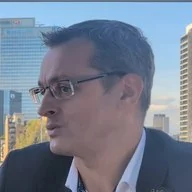
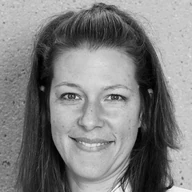
Pascale Hein introduced herself as a sustainability consultant at blocher partners sustain [00:25]. She spoke with Alexander Morari, MRICS, CEO of Shelton Reed, at EXPO REAL 2026 for about 14 minutes. The talk covered German certification, the work behind a label, and why the next standard is the material already standing in the city.
Key takeaway: For Hein, a certificate is the end of a long process, not the point of it. In her words, the risk is "losing the value if you keep the certificate only as a label".
Who is Pascale Hein and what is blocher partners sustain?
Hein said blocher partners sustain is a daughter company of blocher partners, an architecture and interior design practice based in Germany and India. She described the daughter company as leading consultants on certifications such as DGNB, BNB and the EU taxonomy [00:25].
Morari raised the question of what made the parent company move into sustainability consulting. Hein called it a bottom-up decision that grew out of a values process at the firm a couple of years ago: the architects themselves wanted to focus more on sustainability, and a daughter company focused only on sustainability was one step of that process [01:07].
Its focus today is certification in Germany and the DACH region, with an aim to develop in a more international way [01:47].
What should an international investor know about German certificates?
For an international client entering the German market, Hein said the German systems differ from the widely accepted international ones, LEED and BREEAM [02:36]. She named alignment with the EU taxonomy as one of the key points of DGNB certification, which she said is the most common choice for new construction in Germany and the DACH region.
On QNG, she said it defines the minimum quality for buildings that want to receive funding. For the KfW funding for sustainable buildings, only German certifications are accepted, she said, because they share the core of that approach and also ask for minimum criteria such as a life-cycle assessment and benchmarks for pollutants [03:53].
When does a certificate lose its value?
On which certification is hardest to maintain after opening day, Hein said the certificate itself is usually kept and not lost after 10 or 20 years. That suits the owner, she said, but not always sustainability, because sustainability in a building does not end with construction [04:57].
there is a risk of losing the value if you keep the certificate only as a label rather than use the calculated data that is behind the certificate
Pascale Hein, blocher partners sustain [04:57]
The data, she added, can keep improving the building and be handed to the next user, so they know what the building is worth and how to operate it efficiently [04:57].
Do clients certify only to tick a box?
Morari wondered how many clients certify only to tick a box. Hein said it differs by client [06:27]:
- in housing, where funding is large relative to non-residential buildings, many clients chase the label and the funding, which makes projects harder because the value of certification must be explained;
- clients with bigger projects, or those who use SFDR and CSRD to communicate their sustainability numbers, understand the value;
- with those clients, she said, the work is "much more fun" because the focus is on improving buildings and numbers.
What sits behind the label?
Certification, she said, is "the end of a very long process" that starts with strategy and a data assessment of the building [08:18]. Her team does not focus only on receiving a label, she said, and also helps clients improve the lifecycle assessment of a building or compare different sustainability criteria, where one choice can be more cost efficient and another better for embodied carbon.
Why are embodied carbon and urban mining next?
On circular construction, Hein said energy efficiency in new construction is by now a checkbox: the techniques are there [09:52].
the next step in sustainability or in sustainable planning and construction needs to be to deal with embodied carbon
Pascale Hein, blocher partners sustain [09:52]
Because so many buildings already exist, she said, the material stock has to be made available to reduce embodied carbon.
urban mining is a value that is there we just need to make it accessible
Pascale Hein, blocher partners sustain [09:52]
She called it the next standard to establish, and said it is not yet imposed by regulators.
Should the law require pre-demolition audits?
As to whether regulators might impose circular design by law, Hein said that would be the goal. Approval to demolish a building would require a pre-demolition audit that shows the value of the material and gives a chance to rethink demolition [11:06].
Morari suggested a demolition permit only for developers who have a plan for the mined materials, adding that the best building to construct is the one never constructed. Hein agreed with a caveat: some buildings are so inflexible in height or ground floor plan that they are hard to adapt, and then the materials should get a new life, on the same plot or elsewhere [12:49].
FAQ
What should an international investor know about German certification?
Hein said the German systems differ from LEED and BREEAM, that DGNB is the most common choice for new construction in Germany and the DACH region, and that for KfW funding only German certifications are accepted [02:36, 03:53].
When does a certificate lose its value?
By her account, not through the certificate itself, which is usually kept, but when it is held only as a label and the calculated data behind it goes unused [04:57].
What does she see as the next standard?
Embodied carbon and urban mining, which she said is not yet imposed by regulators [09:52].
Watch the PeerView.