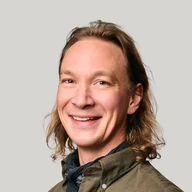
Eelis Rytkönen introduced Foundry Partners Oy as a two-year-old real estate development company focusing on the existing building stock, and described himself as the team's sustainability expert. He spoke with Alexander Morari, MRICS, CEO of Shelton Reed, at EXPO REAL 2026 for about 13 minutes on empty offices and old care facilities, on paper mills that now serve data centres, and on how his team decides what a building should become.
Key takeaway: Rytkönen said they also look into whether a building needs to be demolished, and that "That's usually the last resort". For assets in the zombie class, his words were "we just need to take majority of the useful parts of it and reuse them."
Who is Eelis Rytkönen and what does Foundry Partners do?
We're a two years old real estate development company focusing on existing building stock and finding the best use for it through refurbishment and through conversions basically.
Eelis Rytkönen, Foundry Partners [00:24]
Among the skills in the team, he named [00:24]:
- an architect;
- himself, as a sustainability expert;
- a construction management specialist;
- a transaction specialist.
He said all of this sits under the umbrella of real estate development, "trying to minimize the vacancy rates that are now been rising since covid 19" [00:24].
The Finnish Trade Register lists Foundry Partners Oy as registered on 2024-06-06, with its address on Eteläesplanadi in Helsinki. The company's team page lists Rytkönen as ReGeneralist Partner. On its English pages, Foundry Partners describes itself as "a property development team that owns the result, from diagnosis to delivery". The services it lists include:
- project leadership and construction management;
- architectural design;
- sustainability management;
- partnership leasing and alternative uses.
Which buildings are on the team's radar?
On asset classes, Rytkönen said "offices are the main one" [01:24]. He added a second group.
there's also a huge amount of old social and healthcare facilities in the outskirts in the smaller cities and villages
Eelis Rytkönen, Foundry Partners [01:24]
He said these need some other use or are facing a new use decision in the coming years [01:24]. Their focus is on Helsinki for now, he said, then also Finland, and based on the discussions at EXPO REAL there seems to be a similar kind of problem in Hamburg and around Europe [02:12].
As to which changes of use he sees, he named two obvious ones.
office to housing is pretty obvious as the vacancy rates have been growing in offices, but there's a bigger demand for housing.
Eelis Rytkönen, Foundry Partners [05:48]
Elderly care is another obvious one, as the demographics in Finland are changing.
Eelis Rytkönen, Foundry Partners [05:48]
Statistics Finland reports that at the end of 2025, 24 per cent of Finns were aged 65 or over, 1,347,494 people. The City of Helsinki's Land Use Director said in January 2025 that approximately 200,000 square metres of new residential space have been created in Helsinki through detailed plan changes since 2015, that many office buildings have been converted for residential use, particularly close to the city centre, and that the city aims to approach these conversions with greater flexibility.
How do they decide whether to keep, convert or demolish?
Rytkönen described their biggest project as a refurbishment of a single tenant office building in the very city centre of Helsinki, where they represent a client and act as construction manager [02:29]. They also analyse the best use for other existing buildings, he said, and demolition comes into that analysis.
And we also look, of course, into whether it needs to be demolished. That's usually the last resort, but basically we want to keep it as sustainable as possible
Eelis Rytkönen, Foundry Partners [02:29]
Where a building stays an office, he said, they act as letting partner for the client: "some of the buildings remain in the office use where we see that there's potential" [02:29].
Morari called these buildings zombie assets. Rytkönen said they need to look into the project first, and said:
There are some assets that are in the really dead stock, zombie class. And then we just need to take majority of the useful parts of it and reuse them.
Eelis Rytkönen, Foundry Partners [11:11]
When Morari suggested circular economy, Rytkönen put it at the end of the sequence.
Circular economy, but that's the last stage. The first and easiest is to check whether the company has the letting all right, the processes in there.
Eelis Rytkönen, Foundry Partners [11:28]
The next questions, in his account [11:28]:
- whether better branding, content or a story for the office would help;
- if not, because the location is poor or there is too much vacancy, whether another use would be more feasible;
- the equation behind that choice: the investment capex, the technical and functional side through an architectural study, the demand side with yields and rental levels, and the CO2 emissions.
He said that "usually as an owner you need to order those from different players" [11:28], and that they try to bring it together in an easy format for the client to buy.
How does a young team win work?
Morari wondered how a company this young lands such a big project. Rytkönen pointed to what the team brought with it: "we got quite a vast expertise and we set up the company based on that" [03:58].
On outsourcing, he said they do some on the technical side with a Finnish partner, and partner up if bigger projects come before they grow [04:57].
as a fresh company you need to have the projects and then you need to have the people so it's kind of a chicken and an egg problem
Eelis Rytkönen, Foundry Partners [04:57]
The company's own news pages list recent work:
Why do paper mills suit data centres?
Rytkönen also named more exotic conversions, linked to what he called the huge data center boom that's going on.
There are some paper mills, for instance, that have been converted to data center use
Eelis Rytkönen, Foundry Partners [06:11]
He said that is way wiser than building on green fields with no electricity, as the infrastructure is already there in the paper mills [06:11]. The mills he meant are not active anymore, he said, and people are searching for ways of using them [07:00]. They sit outside urban areas, but there tends to be at least a small city or a village that can use some of the energy from the heat [07:19], to recuperate and reuse it, "And also decrease the eventual NIMBY activists" [07:39].
But we've been also thinking about is there such a thing as sustainable data center?
Eelis Rytkönen, Foundry Partners [06:11]
He said people are very worried whether data centres are a good or a bad thing.
people don't want them to cut down all the fresh land or the woods and the forests so there must be a better way of doing it
Eelis Rytkönen, Foundry Partners [07:53]
He added [07:53]: "It must be located nearer to the places where you've got enough people to utilize the heat."
Google's own page on its Hamina site shows the pattern. It says Google purchased the Summa paper mill in 2009 and opened its first data centre in Hamina in 2011, names "an existing paper mill that could be repurposed into a data centre" among the reasons for the location, and describes seawater cooling and an offsite heat recovery project with Haminan Energia to help warm homes and businesses.
Where does he see Foundry Partners in five years?
Well, our vision is to be the most attractive Nordic developer.
Eelis Rytkönen, Foundry Partners [08:53]
He said they believe a very good starting point for that is that "we can serve the clients from beginning till the end of the project with the different source of expertise" [08:53].
On whether that stays the long-term model, he answered:
That's our long-term vision, yeah. Of course, if the clients say that there's nothing like that that you should be doing, then we won't be doing that.
Eelis Rytkönen, Foundry Partners [10:08]
He gave his reasons as the planet, the economy, feasibility and culture [10:08].
it's very important to have those existing buildings and have some layers in the cities in order to make it more interesting and viable in the long term
Eelis Rytkönen, Foundry Partners [10:08]
FAQ
What kinds of buildings does Rytkönen's team focus on?
He said offices are the main one, and that there is also a huge amount of old social and healthcare facilities in the outskirts, in the smaller cities and villages, that need some other use [01:24].
Which new uses does he see for empty offices?
He called office to housing pretty obvious, as office vacancy has been growing while there is a bigger demand for housing, and named elderly care as another obvious one, as the demographics in Finland are changing [05:48].
When does demolition come into the analysis?
He said they also look into whether a building needs to be demolished, and that this is usually the last resort; basically they want to keep it as sustainable as possible [02:29].
Watch the PeerView.