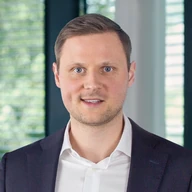
Dr. Christopher Stief is CEO of DCP Data Center Partners GmbH, a developer of data centres in Germany, Austria and Switzerland. He spoke with Alexander Morari, MRICS, CEO of Shelton Reed, at EXPO REAL 2026 in Munich for ten minutes. His message: in Germany, grid connections and approvals set the pace.
Key takeaway:
Stief says that in several German regions a grid connection now goes to the project that proves it will be built, which makes early spending a condition of getting power. He doubts that the substations and power lines needed to double German capacity will be ready by 2030, yet he expects 2027 to be a great year for DCP.
What does DCP build, and why stay out of AI data centres?
Stief described DCP in one line: a data centre developer. It develops two kinds of site, co-location and hyperscale, in Germany, Austria and Switzerland.
Two terms, in plain words. A co-location centre rents space and power to several tenants. A hyperscale centre is a very large site built for the biggest cloud operators.
Morari raised the question of which line is harder. Stief said both have their complexities, but both are a proven business model. He contrasted that with data centres built for AI, which DCP does not do.
We are not in the AI play, two reasons. Because the area of Germany, Austria and Switzerland is much behind the wave of AI in terms of digital infrastructure.
Dr. Christopher Stief, DCP [00:55]
He named the Nordics and France as more attractive regions. France, he said, has nuclear energy and Germany does not.
Is AI demand visible in the megawatts?
Morari wondered whether Stief is an AI sceptic. He called himself a supporter who is also a rationalist.
I'm a supporter of AI, but I also am a rationalist.
Dr. Christopher Stief, DCP [03:24]
His test is deployment. He sees plenty of traction and support for AI, but in his words "from a megawatt deployment perspective it's not there yet". A megawatt is the unit of electrical power a site draws, so it is the measure a developer can count. Morari summed it up as data-driven scepticism, and Stief agreed.
How does a developer win a grid connection now?
The conversation turned to what is hardest about getting a connection. Stief said the situation has changed in several regions.
It's not like the first first come first serve procedure anymore, it's more like you have to really prove that you are going to execute on the data center, so the execution is key here and therefore you really need to spend capex in order to improve your project, in order to progress with your project and then you can show that you are much advanced and then you can apply for the power.
Dr. Christopher Stief, DCP [01:45]
Capex means capital spending. The order matters. A developer pays to advance the project first, and only then applies for power.
Morari condensed it to "first ready, first served". Stief agreed, with a caveat: procedures differ across Germany, and this is one that is in place.
Is a data centre real estate or infrastructure?
Morari put the question to a guest exhibiting at a real estate fair. Stief said DCP has spent several years between the two camps, and it is still unclear to many what the company is.
We are kind of a hybrid in between and I have to say we feel quite comfortable in this position. Changing masks, depending on the context.
Dr. Christopher Stief, DCP [02:45]
Can Germany double its data centre capacity by 2030?
Morari's question framed the doubling of capacity by 2030 as Berlin's ambition. The target is federal: Germany's National Data Centre Strategy aims to at least double data centre capacity in the country by 2030, according to the Bundestag's notice of the strategy of 2026-03-30. Stief widened the question from Berlin to all of Germany, because the situation is the same everywhere. Only four years remain, he noted, and high voltage connections take a long time to put in place.
We don't see the substations getting up and ready until 2030, we don't see that all the power lines and the distribution network gets delivered by 2030 so that makes us a little bit skeptical on that point.
Dr. Christopher Stief, DCP [04:14]
A substation is the site that steps grid voltage down for use. Morari's reply was that paper and red tape may double, but not the data centres. Stief said approvals also take very long in Germany.
On how decisions could move faster, Stief pointed to environmental challenges on projects. He named lizards and bats as examples. Such issues, he said, can stop a project or delay it for years. For a developer who works closely with investors, that is "not very investor friendly". He wants politics to support developers and operators more.
On security, he said there are a lot of cyber attacks on data centres in Germany, but no physical attacks so far. He called the outlook challenging.
What would small modular reactors change?
Morari brought up autonomous power from small modular reactors, compact nuclear units that could sit beside a site. Stief said the idea would help the industry.
So, it would definitely help us and it would definitely help the landscape in Europe.
Dr. Christopher Stief, DCP [07:51]
He sees the United States as probably a couple of years ahead. In Europe, he said, mostly the politics is sceptical.
What does he expect for 2027?
The conversation turned to a forecast. Stief split the answer by place. Berlin is the doubt: he pointed to the recent state election (held on 2026-09-20, per the Federal Agency for Civic Education) and to scepticism towards data centres on the left of the political spectrum. He said it is not yet known whether that will become a bigger challenge.
For other German cities he sees strong demand, especially in co-location, and strong growth from cloud players and hyperscalers.
Therefore I think 2027 will, will be a great year for us.
Dr. Christopher Stief, DCP [09:08]
What to watch
Stief's answers give three things to track rather than three predictions.
- Whether the "first ready, first served" approach spreads across German regions, and how much early capex it asks of developers.
- Whether substations, power lines and distribution networks arrive on a timetable that fits the 2030 target he doubts.
- Whether approval and environmental processes get faster, which he named as the other brake on projects.
FAQ
What does DCP Data Center Partners do?
Stief said DCP is a data centre developer. It develops co-location and hyperscale data centres in Germany, Austria and Switzerland [00:21].
Is DCP building data centres for AI?
No. Stief said DCP is not in the AI play. He said the region is behind on digital infrastructure for AI, pointing to electricity as the main reason, and that the Nordics and France are more attractive [00:55].
How do grid connections work for developers in Germany now?
Stief said it is no longer first come, first served in several regions. A developer has to prove it will execute and spend capex first. Procedures differ across Germany [02:25].
Why is Stief sceptical about doubling capacity by 2030?
He said it takes long to put high voltage connections in place. He does not see substations, power lines and distribution networks ready by 2030 [04:14].
What is the PeerView series?
PeerView is a RealTimes series of executive conversations at EXPO REAL 2026. Morari said at the start of the recording that Shelton Reed sponsors it [00:02].
What does Stief expect for the German data centre market in 2027?
He is cautious on Berlin. For other cities he sees strong demand, especially in co-location and from cloud players and hyperscalers, and expects a great year for DCP [09:08].
Watch the PeerView.