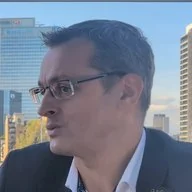
Dr. Casimir Lorenz is Managing Director for Central Europe at Aurora Energy Research, which, as he described it, provides long-term forecasts and other information for investors in the energy sector [00:23]. In a PeerView recorded at EXPO REAL 2026 he discussed with Alexander Morari, MRICS, CEO of Shelton Reed, where grid connection requests pile up, why he calls the grid itself the underlying challenge, what a PPA valuation tool offers data-centre developers, and how he sees long-duration batteries and small modular reactors.
Key takeaway: By Lorenz's account, grid access is not mainly a question of paperwork: "if you don't have enough grid, it's hard to issue more grid connections." [03:29] More grid is expensive, he said, so the grid and the market design have to become smarter.
Where do grid connection requests pile up?
Lorenz said the market sees "a lot of grid connection requests especially for storage assets so battery storage assets but also for data center assets" [01:22]. He described two sides, generation and demand, and named "batteries and data centers" as the biggest issues. Renewables are, in his words, "maybe it's a third point": "a lot of generation and grid connection requests", but "they are less new to the game so I think the grid operators are more used to them" [01:22].
Morari wanted a top three of locations where energy is most needed but least available. Lorenz's answer depended on the sector: "the biggest growth in demand is really a question which sector do you look at" [02:21]. For data centres he saw growth "all across Europe", with Germany "one of the biggest markets" and, where energy is cheapest, "quite a big demand in the Nordics, even though the market itself is rather small" [02:21]. On the German market, he said, "we do have quite some issues with grid connection approvals, especially on the data center side." [02:21]
Is the real problem administration or the missing grid?
Morari put it as an administrative burden hindering business development and looked for one or two hacks to improve the administrative decision process [03:01]. Lorenz saw it differently: "it's less just administrative" [03:19]. In his view, "the underlying challenge is that we don't have the grid" [03:19].
He used a comparison with roads: "as if you don't have enough roads, it's hard to build and do construction work" [03:29]. The grid works the same way: "if you don't have enough grid, it's hard to issue more grid connections." [03:29] Building more grid is expensive, he said, and "we don't want to build as much grid as maybe some people require" [03:29]. His answer is that "we need to do the grid and the market design smarter" [03:29]. In essence, he said, that means:
- giving developers of data centres, storage and renewable assets more information on "where there's good infrastructure and where there's not so good infrastructure" [03:29];
- giving them "the right market signals" [03:29].
On the price side, he said Germany, like many other countries, has one price zone, one price for the entire country, and "this is sometimes making it challenging" [03:29].
What does the PPA valuation tool do, and who uses it?
Morari turned to one of Aurora's products, a PPA valuation tool, and wanted to know what it is and who the target client is [04:26].
Lorenz named two groups of clients. One is "the ones producing electricity so the ones that are developing renewables or batteries that wants to sell their electricity through long-term contracts to off-takers" [04:42]. The other is the off-takers, who he said "can be data centers but can also be larger real estate companies" [04:42]. The tool should "provide pricing transparency to both parties, to the off-take side as well as the production side" [04:42]. With it, "you can actually get insights into what is the current market price and what's the market price, which you can either buy electricity for or sell electricity for long-term" [04:42].
For a data-centre developer, he described three benefits [05:41]:
- knowing "in which countries can I expect what kind of long-term electricity prices which I can lock in";
- the option to "lock these electricity prices in for five to ten years and thereby achieve some more certainty";
- green electricity, which "is important for many of the data center providers".
"I'm not exposed to any fluctuations anymore if I go for PPA," he said [05:41].
What could be the next breakthrough in energy?
Morari set the horizon at five to ten years [06:12]. Lorenz began with the present: "I think the biggest breakthrough we're living now is actually batteries, right?" [06:29] His reason: "Batteries five years ago have been extremely expensive. Now they're very much cheaper." [06:29] What comes next, he said, "it's still quite an open point" [06:29].
One option, he said, could be longer storage. "Long duration energy is what we need in order for system security," he said [06:29]. Today, "two to four hours is the duration a battery can store" [07:57]. The threshold he named: "if we really manage to get the 12, 14, 24 or even longer battery storage is commercially viable" [06:29]. Then, he explained, "you can use electricity not necessarily when it's produced but when you need it" [06:29]. With 12, 24 or maybe even 48 hours, "you can also balance out larger periods of low renewable production" [07:57]. His caveat: "this is something which is currently too costly still, but this could be a breakthrough." [07:57]
Are small modular reactors more than hype?
Morari raised small modular reactors and whether they are a hyped topic [08:24]. Lorenz: "It's definitely a hyped topic. The question is how much is there behind it." [08:30]
His reasoning starts with cost: "The challenge with, let's say, nuclear-fueled power plants has been that the cost declines have never materialized." [08:30] In Europe, he said, "costs have not gone down, they've gone up with every new generation" [08:30]. "If SMRs can manage to turn this around by having high quantities and very standardized, they can be a chance." [08:30]
It remains open for him: "it's still a bit of a question mark if we can really realize these cost declines" [09:00]. By then, "we will have cheaper renewables, cheaper batteries", so the question is how far reactors are still needed. And "if they're cheap enough there will be for sure room for them" [09:00].
What does he wish for in 2027?
Morari framed it as a new year's resolution: what Lorenz would like to see in 2027 to improve the energy situation in Europe [09:16]. His first wish: "I would wish that we would manage to get grid constraints or problems we have in the power grid more into the markets" [09:31], "such that market prices that we're seeing include grid constraints" [09:31].
The second concerns the flexibility already visible through batteries: "having the right information to actually build at the right places, consume at the right places, consume in the right moments" [09:31]. His summary: "there's a lot we can do with better information and better price signals" [09:31].
Morari closed the conversation by thanking him [10:27].
FAQ
Why does he say the grid, not administration, is the bottleneck?
Lorenz said the underlying challenge is that "we don't have the grid", and compared it to roads: without enough of them, building is hard [03:19, 03:29].
How can a data-centre developer use the PPA valuation tool?
By his account, the developer learns which long-term electricity prices to expect in which countries and can lock them in "for five to ten years" [05:41].
What does he see as the next breakthrough after today's batteries?
Longer storage of 12, 24 or maybe even 48 hours, which he called currently too costly: "this could be a breakthrough" [07:57].
Watch the PeerView.