
TL;DR
- A Paris tower refurbishment collapsed in July 2026. Tour Montparnasse co-owners declared a 727.7m EUR works programme lapsed and approved only a strip-out phase, with the 2019 permit expiring on 26 November 2026.
- The carbon case for retrofit is settled in law. From 1 January 2028 every new EU building above 1,000 sqm must disclose its life-cycle global warming potential on its energy performance certificate.
- The carbon case against height is weaker than the argument it feeds. University of Toronto research across 128 concrete buildings found a 50 mm increase in slab thickness outweighs a 15-storey increase in height.
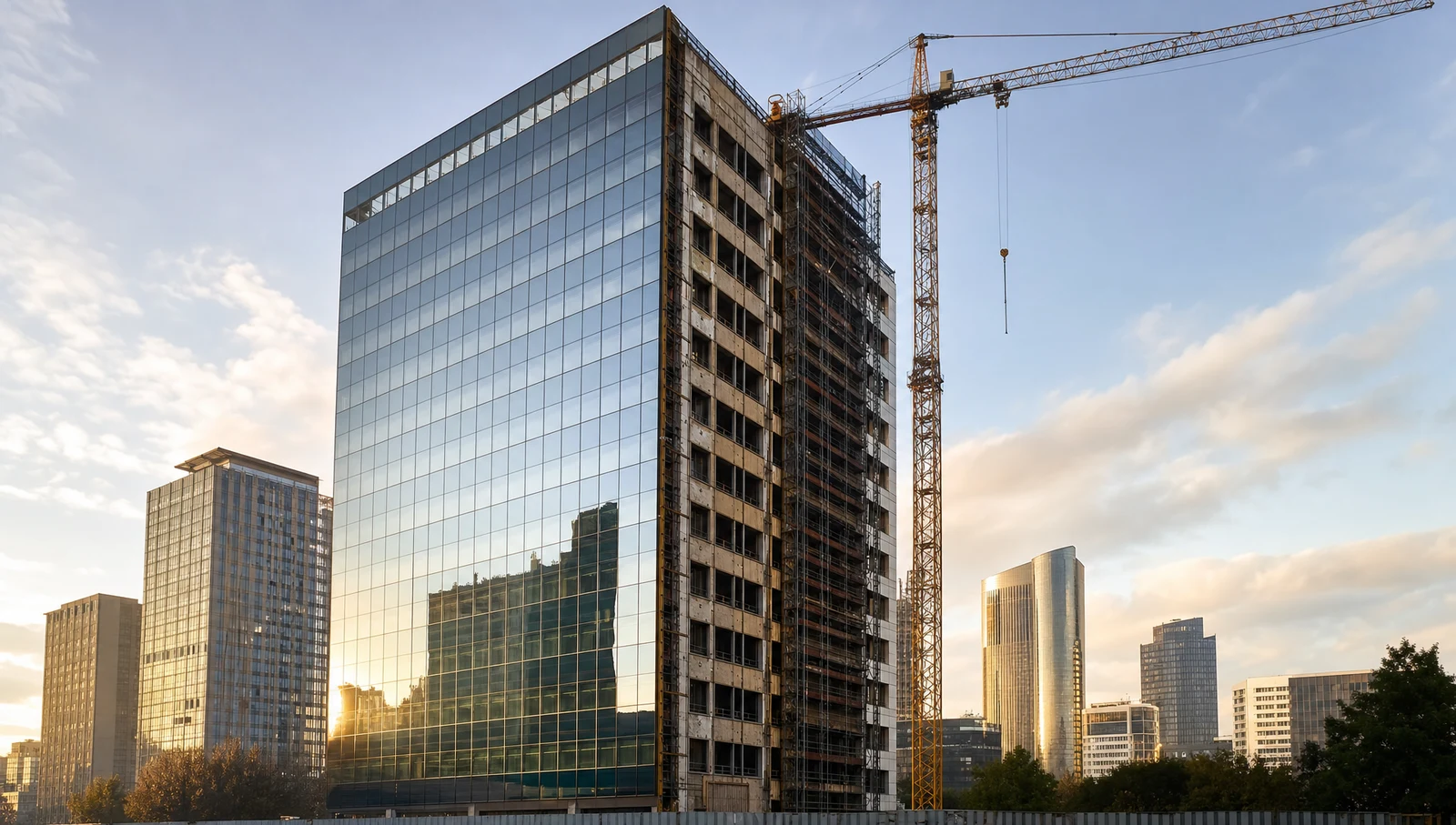
Retrofit has won the European rulebook. Paris made rehabilitation the norm in November 2024. The City of London made it planning policy in January 2025. Brussels turned embodied carbon into a number on a certificate. And then, on 21 July 2026, the co-owners of Tour Montparnasse declared their own 727.7m EUR refurbishment programme obsolete and approved a partial strip-out instead.
That is the state of play. The policy argument is finished. The financing argument has barely started. For anyone underwriting a 1970s or 1980s European tower, the gap between the two is where the risk now sits.
The height penalty is real, and smaller than the fight over it
Tall buildings do cost more carbon per square metre. Wind and gravity loads accumulate, so structure gets heavier as height rises. Edinburgh Napier University researchers used 250 kgCO2e per sqm of floor area for the structure of high-rise buildings, against 180 kgCO2e for low-rise structures and 90 kgCO2e for single-family homes. Those figures cover structure only, not the whole building.
By the numbers
- 250kgCO2e/sqmHigh-rise structural embodied carbonagainst 180 for low-rise structures, structure onlyEdinburgh Napier University via USGlass
- 350kgCO2e/sqmLETI office band A ceilingupfront carbon A1-A5; band C is 600, the 2020 targetLETI via RICS
- 1.3%Added embodied emissions per storeyabove 10 storeys, 128 concrete buildings modelledHoffer, Bentz & Saxe
- 40,000tonnesM&S Marble Arch embodied carbonapproved anyway on 5 December 2024Architects' Journal
- 727.7EUR mTour Montparnasse programme declared lapsed21 July 2026, excluding tax; revised estimates near 800mLa Cle Publique
- 18ppsRise in the premium for buildings under five years oldeuro area offices, 2007 to 2023ECB Working Paper No 3059
But the size of the penalty has been overstated. Avery Hoffer, Evan Bentz and Shoshanna Saxe of the University of Toronto modelled 128 reinforced-concrete residential buildings of 5 to 20 storeys. Emissions per rentable area rose 3% between 5 and 10 storeys, then about 1.3% per storey to 20. Slab thickness mattered more. A 20-storey building with 175 mm slabs carried less embodied carbon per sqm than a 5-storey building with 225 mm slabs, and slabs alone drove 60% to 75% of structural emissions. Their published conclusion, in the March 2026 issue of Resources, Conservation and Recycling, is that the tall-buildings debate is aimed at the wrong variable.
Two caveats travel with that finding. It covers residential concrete buildings to 20 storeys, not the supertalls discussed in engineering the supertall. And it measures relative penalty, not absolute performance. The benchmark that matters commercially is LETI banding, where an office scores band A below 350 kgCO2e per sqm of upfront carbon and band C below 600. LETI treats band C as 2020 practice and band A as the 2030 design target. Structure is typically half to 60% of that total.
The debate around tall buildings and sustainability is too often focused on the wrong question.
Hoffer, Bentz & Saxe, University of Toronto
Timber is the material answer, and Europe's proof points stay short. HAUT in Amsterdam reaches 73 m over 21 storeys in cross-laminated timber on a concrete core, completed in 2022. That is a mid-rise solution to a high-rise problem.
Brussels turned embodied carbon into a disclosed number
The recast Energy Performance of Buildings Directive, 2024/1275, is where disclosure stops being voluntary. Member States had to transpose it by 29 May 2026. From 1 January 2028 the life-cycle global warming potential of every new building above 1,000 sqm must be calculated and disclosed on its energy performance certificate, and of every new building from 1 January 2030.
The parallel provision hits the standing stock harder. Each Member State must identify its worst-performing 16% of non-residential buildings and renovate them by 2030, then extend the same treatment to 26% by 2033, against nationally set thresholds. For the owner of a 1975 office tower, that is a dated compliance event with a capex number attached, not a market preference to be timed.
Planning made retrofit the default, then the courts tested it
The test case was Marks & Spencer at Marble Arch. Michael Gove refused the Oxford Street demolition and rebuild in July 2023, weighing the roughly 40,000 tonnes of embodied carbon the scheme would release. On 1 March 2024 the High Court quashed that refusal, with M&S succeeding on five of six grounds. On 5 December 2024 Angela Rayner approved the scheme, accepting the carbon harm and finding it outweighed by regeneration and employment benefits.
Retrofit-first did not lose. It simply failed to win automatically, and the rules tightened anyway:
- The London Plan requires a whole life-cycle carbon assessment on every application referable to the Mayor, over a 60-year study period, with retention and retrofit explored before substantial demolition.
- The City of London Corporation's Planning for Sustainability guidance, reported on 22 January 2025, sets five-star NABERS UK for new offices and four-star for retrofits, on a retrofit-first approach.
- Paris approved its PLU bioclimatique on 20 November 2024 and brought it into force on 29 November, making rehabilitation the norm, demolition-reconstruction the exception, and material reuse a requirement.
- Frankfurt's high-rise plan, approved by the city council on 14 June 2024, identifies 14 new high-rise projects and avoids demolition at four sites in favour of vertical extension, explicitly to limit embodied energy.
Those are the planning politics traced in height rules. The point here is narrower: four jurisdictions independently concluded that the existing structure is an asset to be counted, not a cost to be cleared.
Older buildings, which are more exposed to transition risks, may already be at risk of becoming stranded assets.
Foerster, Ryan & Scheid, ECB Working Paper No 3059
Retrofit is losing on the balance sheet, not the carbon maths
Where owners are single and decisive, the method works. Paris La Défense reported more than 250,000 sqm, about 8% of the district's stock, completing restructuring across 2024 and 2025. Hopen is the clearest case. Rather than demolish the Adria Tower, Praemia REIM France and Eiffage added three floors and delivered 155 m and 65,000 sqm in the first quarter of 2025, targeting HQE and BREEAM Excellent.
Where ownership is fragmented, it does not. Tour Montparnasse emptied its last occupants on 31 March 2026 for a refurbishment designed by Nouvelle AOM, the Franklin Azzi, ChartierDalix & Hardel Le Bihan team that won the 2017 competition. On 21 July 2026 the general assembly recorded the programme as lapsed, with revised estimates approaching 800m EUR. Co-owners approved only a two-year first phase of strip-out, asbestos removal and partial facade removal to the fourth floor. LFPI, the principal owner, opposed the package. The 2019 building permit runs out on 26 November 2026. Nothing about the carbon case changed. The disputes were over hotel floors, surface exchanges and rooftop rights.
Warsaw gives both answers on one skyline. Polski Holding Nieruchomości is demolishing Intraco, built in 1975 at 107 m over 39 floors, and replacing it with a tower of identical height and 23 floors by 2030. Deconstruction alone runs 12 to 16 months. That is the same calculation reached the other way, on the obsolescence question, in a skyline built fast.
Capital has moved ahead of the regulation, but only through liquidity. ECB Working Paper No 3059, by Kai Foerster, Ellen Ryan and Benedikt Scheid, is the first study of climate risk pricing in euro area commercial real estate. It found the premium for buildings under five years old rose 18 percentage points across 2007 to 2023, and a clear shift of transaction activity away from older buildings from 2018. The authors read that as owners of older assets struggling to find buyers rather than being explicitly repriced.
The explicit price stays small. AEW put its European climate transition risk premium at 26 basis points a year in July 2025, up 37% on the prior estimate, with offices at 19 bps. Against anticipated 2025 to 2029 total returns of 8.1% a year, that is a rounding item, as the cap-rate arithmetic in the economics of height makes plain. AEW's retrofit cost assumption of 14 EUR per sqm a year is the number doing the real work.
Winners & losers
Who gains:
- Single-owner towers with reversionary income, where a retrofit decision needs one signature and clears the EPBD 2033 threshold in one programme.
- Structural engineers and slab specialists, because the Toronto evidence puts the material saving in floor plates rather than in storey counts.
- Buyers of 1970s and 1980s stock at liquidity-discounted prices, if they can underwrite the works.
Who pays:
- Fragmented co-ownerships, where the Montparnasse outcome shows that a valid permit, a designed scheme and a carbon rationale do not substitute for an owner agreement.
- Owners inside the worst-performing 16% of non-residential stock, who face a fixed 2030 date and a rising cost base.
- Developers of new towers, who from 2028 must publish a number that competitors, tenants and lenders can compare.
What to watch
Three dates decide this. The Tour Montparnasse permit expires on 26 November 2026, and whether the first phase starts before then will show whether the scheme is delayed or dead. Through 2027, national transpositions of the EPBD turn a directive into specific limit values, and tall schemes will learn whether they are treated as a category. Then 1 January 2028, when life-cycle carbon appears on certificates for new buildings above 1,000 sqm. A disclosed figure becomes a comparable figure, and a comparable figure eventually becomes a priced one. That is the shift under Europe's tall-building map, under why height still matters, and across this Skyscraper Day Dive.