
TL;DR
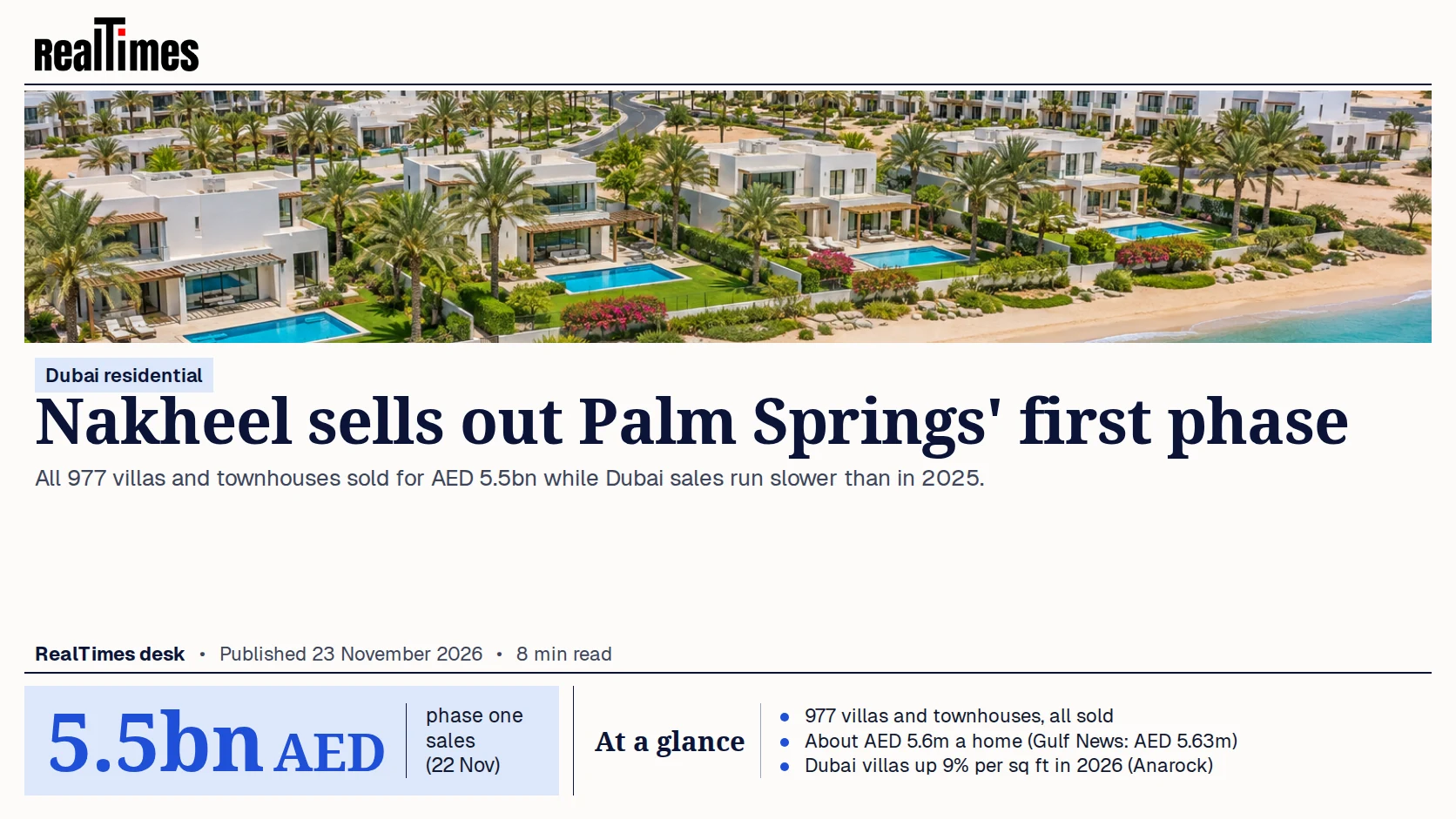
- Nakheel sold all 977 villas and townhouses in the first phase of Palm Springs, near Palm Jebel Ali, for AED 5.5bn, about $1.5bn, according to figures released on 22 November, carried by the state news agency WAM and reported by The National, Khaleej Times and Gulf News.
- The phase was launched on 18 November, in a week when Iran targeted an airbase used by the US military in Kuwait and Bahrain faced four Iranian attacks in six days, per Al Jazeera.
- The sale works out at about AED 5.6m a home, well below Anarock's AED 14.6m average Dubai villa price for 2026. The desk reads it as evidence that family homes priced below the villa average, not the top of the market, are where Dubai demand is holding.
Nine hundred and seventy-seven homes, one release, and buyers who did not wait for the region to calm down. That is the result Nakheel, the developer of Palm Jebel Ali and part of state-owned Dubai Holding Real Estate, put out on Sunday for the first phase of Palm Springs, a new suburb in the south of the city.
What did Nakheel sell, and how fast?
The first phase of Palm Springs consisted of 977 homes: three and four bedroom Aliso townhouses with private gardens, and four and five bedroom Rancho villas with courtyards and pools, according to WAM and Gulf News. All of them sold, for total sales of AED 5.5bn. The National attributes the figures to the Dubai Media Office; WAM carried the same release.
The timeline was short. Nakheel unveiled the masterplan on 10 November and launched the first villas and townhouses on 18 November, Khaleej Times reports. When the launch was announced, Nakheel did not disclose starting prices or a completion date, per the Khaleej Times launch report of 18 November.
Dividing AED 5.5bn by 977 homes gives about AED 5.6m a home. Gulf News puts the average at about AED 5.63m and notes that individual prices vary by type and size.
Who is behind Palm Springs?
Nakheel is part of Dubai Holding Real Estate, which is state-owned, as The National describes it. Palm Springs sits near Palm Jebel Ali, Nakheel's island scheme, in what Khaleej Times calls Dubai's southern growth corridor.
The masterplan covers 3.8m sq m across 15 neighbourhoods and is planned for almost 50,000 residents, according to the Khaleej Times launch report. Two schools, a hospital, six mosques and more than 35 km of walking and cycling routes are planned, with links to Sheikh Zayed Road and Al Maktoum International Airport. Further phases are planned and bookings for the next release are expected to open soon, Gulf News reports; the developer has not disclosed their size or prices.
Khalid Al Malik, chief executive of Dubai Holding Real Estate, framed the result as a change in what buyers want. "The robust response to Palm Springs reflects a clear shift in what people are looking for in a home," he said, as quoted by Khaleej Times. "Families are thinking beyond the property itself and placing greater value on the communities and lifestyles around it," he added, per Gulf News. Nakheel's statement says Dubai residents are increasingly buying homes to live in rather than purely as an investment, Khaleej Times adds.
Is the Dubai market slowing?
The pace of the market is lower than last year. Anarock counts 122,583 homes sold in Dubai in the first ten months of 2026, about 12,100 deals a month against about 16,600 a month in 2025, The Realty Today reports. The daily sales rate is about 27% below the 2025 pace, and the same report says regional geopolitical tensions weighed on activity in the second quarter.
Moody's sees the same cooling at the developer level across the UAE. Sales volumes at the UAE developers it covers are "around half of their previous peaks," Khaleej Times reported on 18 November. The agency notes some softening in Dubai's ultra-luxury segment, while pricing, construction and customer collections have "generally held up".
Prices tell a different story from volumes, and they split by product. Anarock puts the citywide average at AED 1,967 per sq ft, the highest in the four years it tracks.
Dubai residential prices by type, first ten months of 2026 (Anarock)
| Type | Average price per sq ft, 2026 | Change on 2025 |
|---|---|---|
| Villas | AED 2,362 | up 9% |
| Townhouses | AED 1,399 | up 7% |
| Apartments | AED 2,049 | down from AED 2,078 |
| All homes | AED 1,967 | highest in four years |
Source: Anarock via The Realty Today, 18 November 2026. Anarock attributes the apartment dip mainly to a larger share of smaller units in sales.
Villas and townhouses made up about 15% of deals but roughly 41% of the AED 318.4bn spent in the period, Anarock's figures show. The average Dubai villa sold for AED 14.6m in 2026, up from AED 12.7m in 2025.
Which segment is holding up?
The desk's reading is that Palm Springs sold into the gap between those numbers. At about AED 5.6m a home, the phase sits well below Anarock's AED 14.6m average villa, and its mix is townhouses and family villas rather than trophy stock. It is still about twice Anarock's average Dubai ticket of about AED 2.6m, which is mostly apartments, so the phase is mid-market for a villa, not for the city.
The comparison is not like for like: Anarock covers the whole city and every type of villa, while Palm Springs is one off-plan release. But it points the same way as Moody's, which notes softening in Dubai's ultra-luxury segment.
The buyer profile Nakheel describes, families buying to live in, fits that reading. So, in our reading, does the seller: a developer inside state-owned Dubai Holding is a counterparty off-plan buyers can underwrite when the headlines turn uncertain.
Why it matters
Our view: the Palm Springs result separates two Dubai markets that are often read as one. Volumes are running about 27% below the 2025 pace and rated UAE developers sell around half of their peak volumes, yet a 977-home release of family villas and townhouses at about AED 5.6m a home was announced as sold out four days after its launch.
If the next Palm Springs release clears at similar prices, then developers have a case to tilt 2027 launches toward family communities priced below the villa average on the city's southern edge, and villa prices, already up 9% this year, keep pulling away from apartments. If it sells more slowly, then the first phase reads as pent-up demand for one state-backed brand, and the wider slowdown is the better guide to 2027.